Reviewed by the XROSS HOUSE team — a Tokyo-based operator of share houses and furnished apartments across 11 prefectures in Japan, with more than 50,000 residents housed to date.
There is no single "Japan work visa": you need a work-permitting status of residence that matches your job, and your employer usually starts the process.
- Most office, IT, marketing and language-service jobs use the "Engineer/Specialist in Humanities/International Services" status.
- Your employer normally applies for a Certificate of Eligibility (COE); the standard processing period is 1 to 3 months.
- A COE can arrive by email, and it is valid for 3 months, so plan your entry date around it.
- After landing, register your address within 14 days. That step needs a real address, so sort out housing early.
- If you change employers, you must notify immigration within 14 days.
Got a job offer in Japan? Talk to our team about your first home
What "Japan work visa" really means
People search for "Japan work visa", "Japan work permit" or "employment visa Japan", but Japan does not have one visa for all jobs. It has a list of statuses of residence, and each one allows a specific type of work. The ISA page for Engineer/Specialist in Humanities/International Services covers work that needs knowledge of natural sciences, or of humanities fields such as law, economics and sociology, or that draws on a foreign cultural perspective. Examples listed include engineers, interpreters, designers and marketing staff (as of October 2026).
If you work in an office for a company in Japan, this is very likely your status. The visa sticker you get abroad is only the entry ticket. The status of residence, shown on your residence card, is what defines what work you may do.
Two practical points follow from that. First, your job duties must fit the status you hold. Second, there is almost always a sponsor: a Japanese employer or other organization that applies for your Certificate of Eligibility. The ISA says the COE application can be made by the foreign national or by staff of the receiving organization, and the receiving organization is the usual route for workers abroad. See the ISA page on the COE application.
Main Japan work statuses compared
The table below compares the statuses most readers ask about. Information is from the Immigration Services Agency of Japan (ISA) and is current as of October 2026. Always confirm details on the linked pages, because criteria are revised from time to time.
| Status | Who it is for | Key requirement | Typical period of stay |
|---|---|---|---|
| Engineer/Specialist in Humanities/International Services | Office, IT, engineering, design, marketing and translation or interpreting jobs | University degree or equivalent, or relevant work experience; a job that fits the status | 5 years, 3 years, 1 year or 3 months |
| Highly Skilled Professional (i) | Researchers, specialists and business managers who score well on a points table | 70 points or more on the ISA points system | 5 years |
| Intra-company Transferee | Employees of a company's overseas office transferred to its Japan office | Documented work at the overseas office for the year before transfer | 5 years, 3 years, 1 year or 3 months |
| Instructor | Language and other teachers at elementary, junior high, high schools and similar institutions | Relevant education or qualifications, plus a contract with the school | 5 years, 3 years, 1 year or 3 months |
| Skilled Labor | Specialized skilled trades such as foreign-cuisine chefs and sports instructors | Skilled work under a contract; documents vary by occupation | 5 years, 3 years, 1 year or 3 months |
| Specified Skilled Worker (i) / (ii) | Workers in designated fields with labor shortages | Field-specific requirements; (ii) is for higher-skilled workers | (i): set individually, up to 3 years, 5 years in total in principle. (ii): 3 years, 2 years, 1 year or 6 months |
| Business Manager | People who run or manage a business in Japan | Criteria were tightened on October 16, 2025; check the ISA page | 5 years, 3 years, 1 year, 6 months, 4 months or 3 months |
Two more options exist for people who want to work in Japan for a limited time. The ISA lists Designated Activities, which includes working holiday arrangements and a digital nomad category. The digital nomad status is for remote work for foreign employers or clients, not for employment with Japanese organizations, and the ISA digital nomad page sets a stay of six months with no extension and an income minimum of 10 million yen a year at application. For working holiday housing, see our working holiday housing guide.
Highly Skilled Professional: the points route
The Highly Skilled Professional system scores factors such as academic background, career history and annual salary. According to the ISA Q&A on the points system, a score of 70 points or more brings preferential treatment: a 5-year period of stay, and faster eligibility for permanent residence (3 years at 70 points, 1 year at 80 points). We cannot score you, so use the ISA points calculation table with your employer.
Business Manager: check the latest rules first
Business Manager criteria changed on October 16, 2025. The ISA notice on the amended criteria lists capital of 30 million yen or more, at least one full-time employee, Japanese ability at about B2 level, and a master's degree or three years of management experience. Read the notice in full before planning a company in Japan.
Planning your move for work? Ask about your first home
Search for a room
Only furnished properties with appliances are listed!
Requirements for the Engineer/Specialist in Humanities/International Services status
This is the status most office workers receive, so here is what the ISA asks for. The official page lists the following (as of October 2026).
- Education or experience. For technology or humanities work, a university degree or equivalent education, or documents proving relevant work experience. For international services work (for example interpreting or work that relies on a foreign cultural perspective), the page asks for documents proving three or more years of related practical experience.
- A job that matches the status. The duties in your contract must fall within the activities described above. A role that is mainly manual or unrelated to your field is a different question.
- Fair pay. Your pay must be equal to or higher than a Japanese national would receive for the same work. The ISA treats pay below that level as a reason for refusal.
- Language evidence in some cases. Since April 15, 2026, for some employer categories where the role is mainly language-based and customer-facing, the ISA asks for evidence of language ability at about CEFR B2 for the working language.
Your employer prepares most of the paperwork, and the ISA decides each case individually. We cannot judge whether you personally qualify. Ask your employer's HR team, and use the government's Foreign Residents Support Center (FRESC) for questions about your own case.
If you teach English, our guide to teaching English in Japan explains how these statuses apply to teaching jobs. If you are a graduate deciding between study and work, read our Japan student visa guide.
Step by step: from job offer to first day
This sequence applies to most people moving from abroad (as of October 2026). Documents differ by embassy and by employer category, so check the details for your case.
- Get a job offer and a contract. The contract should describe your duties, pay and employer. These documents support the immigration application.
- Your employer applies for the COE. The application is filed in person at the regional immigration services bureau that covers the planned residence or the employer's location; mail is not accepted. The ISA page gives a standard processing period of 1 to 3 months.
- Receive the COE. Since March 17, 2023, the COE can be delivered by email. The ISA e-COE page says an emailed COE, including a forwarded one, can be shown at the embassy and at the airport.
- Apply for the visa abroad. Take your COE, passport and the other documents your embassy requires to the Japanese embassy or consulate in your country or region. See the Study in Japan immigration procedures page for the general flow.
- Enter Japan within 3 months. The COE is valid for 3 months from the date of issue.
- Land and collect your residence card. At major airports (New Chitose, Narita, Haneda, Chubu, Kansai, Kobe, Hiroshima and Fukuoka) you receive your residence card together with landing permission.
- Register your address. Within 14 days of settling at your address, go to the city or ward office with your residence card and passport.
- Join insurance and pension. At most companies, your employer enrolls you in Employees' Pension Insurance and Employees' Health Insurance. The Japan Pension Service says the employer submits the enrollment application, and employees are covered regardless of nationality. If your workplace is not covered, you join National Health Insurance at the municipal office instead; see the Study in Japan insurance page.
Processing times and criteria change. Confirm the latest details with your employer, the ISA and your embassy. This article is general information, not legal advice or a judgment on your eligibility.
If you are coming from the United States, our guide to moving to Japan from the U.S. covers the practical side of the move. Indian readers can also see jobs in Japan for Indians, which looks at the job-hunting side.
Search for a room
Only furnished properties with appliances are listed!
After you arrive: changing jobs, renewing and bringing family
Changing jobs
Holders of the Engineer/Specialist in Humanities/International Services status, and several other work statuses, must notify immigration within 14 days when they leave an employer or join a new one. The ISA notification page says you can file online, in person at a local immigration bureau, or by mail to the Tokyo Immigration Bureau. The same page says notification is also needed when the employer changes its name, moves or closes. If your new job is in a different field, ask the ISA whether it still fits your status.
Renewing your period of stay
Your residence card shows when your period of stay ends, for example 5 years, 3 years or 1 year. Check the date when you arrive, and apply to extend at your regional immigration bureau before it passes. Your employer's HR team can usually help with the documents.
Bringing your family
Spouses and children of many work-status holders can apply for the "Dependent" status. The ISA Dependent page sets a period of stay of up to 5 years. Dependents who want to work can apply for permission to engage in activity other than that permitted; with comprehensive permission, work is limited to 28 hours a week.
Where to live in your first weeks
Step 7 above needs an address. A hotel or short Airbnb stay can make address registration and later paperwork harder, because you will move again soon. Many new arrivals want a place that is ready for them to move into, with a short contract and a clear address from day one. Our moving to Japan housing guide compares the options, and our Japan rental contract guide explains how contracts work. For budgeting, see cost of living in Japan.
Hotel, regular rental or furnished apartment?
| Hotel or short-term rental | Regular Japanese rental | XROSS HOUSE furnished apartment | |
|---|---|---|---|
| Address registration | Usually not possible | Possible | Possible |
| Furniture and appliances | Included | You buy them | Included |
| Signing from abroad | Yes | Often difficult before you have a residence card and a Japanese phone number | Online contract from abroad |
| Upfront payments | Nightly or weekly rate | Deposit, key money and agency fee often add up to several months' rent | No deposit or agency fee; a flat registration fee plus guarantee fees and rent paid in advance (see below) |
| Minimum stay | None | Usually a 2-year contract | From 1 month |
Practical tips for your first two weeks
- Bring your residence card and passport to the city or ward office. March and April are the busiest months, so go early in the day.
- Your registered address is needed for a Japanese bank account, a phone contract and your employer's payroll, so register before you start those.
- Give your employer your address and residence card number once you have them; HR needs both for insurance and pension enrollment.
- If you pick a place you can stay in for a few months, you avoid registering a second address soon after the first.
XROSS HOUSE furnished apartments: your own space, ready to move in
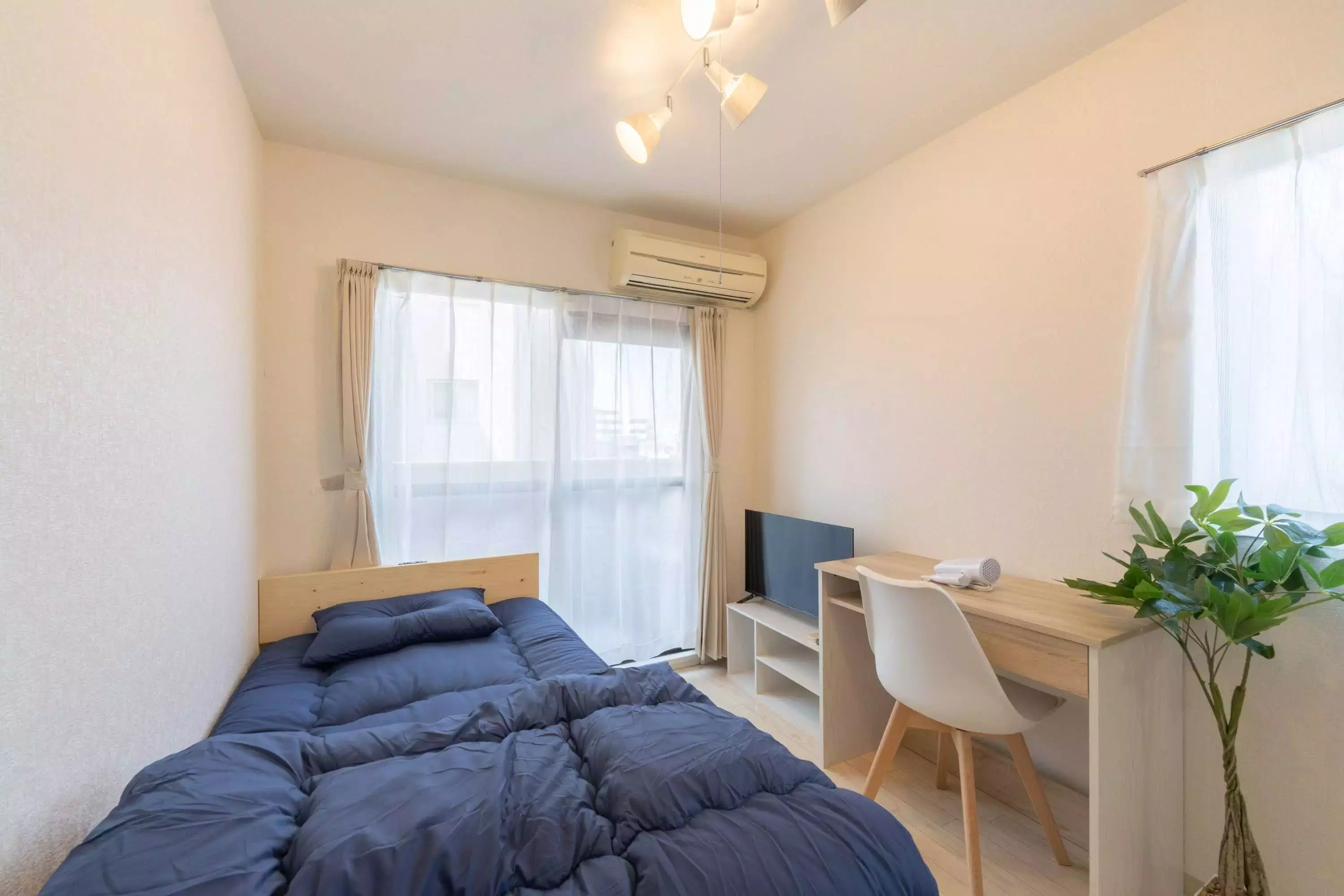
A furnished apartment is your own room with a private kitchen and bathroom. Furniture and appliances are already inside, so you can arrive with a suitcase and start your new job. Because you have a real address, you can register at the city office right away. Furnished apartments are an easy base while you find your feet, and they suit people who value privacy for work calls and focus.
Share houses: a lower-cost start
A share house gives you a private or shared room and shares the kitchen, bathroom and living room. It usually costs less to start, and you meet other residents from day one. It works well for newcomers who want a social first few months.
What you pay when you move in
Initial costs for a typical Japanese rental (deposit, key money and agency fee) often reach several months' rent. XROSS HOUSE keeps them lower and lists each item before you apply:
- Registration fee: ¥30,000 for share houses; ¥50,000 for furnished apartments (discount campaigns sometimes lower this).
- Rent in advance: the remaining days of your move-in month, plus the next month if you move in on or after the 20th.
- Guarantee company fees: for individual contracts, the initial guarantee fee and two months of the monthly guarantee fee (see below).
- When you leave: a move-out fee of ¥16,500 for share houses or ¥55,000 for furnished apartments. Give one month's notice; there is no early-termination penalty.
Do you need a guarantor?
- No individual joint guarantor is needed.
- For individual contracts, joining a rent guarantee company is generally required. An initial guarantee fee and a monthly guarantee fee are charged separately, on top of the registration fee, and the details are confirmed at application.
- If you pay everything from the initial costs through the move-out costs in one payment upfront, you do not need to join a guarantee company.
Arranging it before you arrive
All statuses of residence are accepted. You can view rooms online and sign an online contract from abroad, and the earliest move-in is 7 days after application. If your employer wants to arrange housing for you, XROSS HOUSE offers corporate contracts, used by more than 650 companies. Corporate contracts do not require a guarantee company. Our team supports you in English, Japanese, Chinese, Korean and more.
Ask about furnished apartments and share houses
Search for a room
Only furnished properties with appliances are listed!
FAQ: Japan work visa
Can I apply for a Japan work visa without a job offer?
In most cases, no. The Certificate of Eligibility is based on a contract with a Japanese organization, and the ISA says the receiving organization's staff usually file the application. Without an employer, look at other routes such as study, working holiday (for eligible nationalities) or digital nomad Designated Activities, each with its own rules. See the ISA COE application page.
How long does a Japan work visa take?
The ISA gives a standard processing period of 1 to 3 months for a Certificate of Eligibility. After that you apply for the visa at the Japanese embassy or consulate, which adds more time. Because your employer files first, ask HR for a realistic start date. See the ISA COE page.
Can I change jobs on a work visa?
Yes, as long as the new job fits the activities your status allows. You must notify immigration within 14 days of leaving an employer or joining a new one, online, in person or by mail. If the new work is in a different field, ask the ISA whether you need a change of status. See the ISA notification page.
Do I need a university degree for a Japan work visa?
For the Engineer/Specialist in Humanities/International Services status, the ISA accepts a university degree or equivalent education, or documents proving relevant work experience. For international services work, it asks for three or more years of related experience. Other statuses, such as Skilled Labor and Specified Skilled Worker, have their own requirements. See the ISA status page.
Can I work part-time on a work visa?
Your status limits the work you may do. Extra work outside your status needs permission to engage in activity other than that permitted, which you request from the immigration bureau; it is not automatic. Ask the ISA or FRESC before you take a second job. See the ISA page on permission for other activities.
What is the difference between a COE and a visa?
The Certificate of Eligibility is issued in Japan by the regional immigration bureau after your employer applies. You then use it to apply for the visa at a Japanese embassy or consulate abroad. The COE is valid for 3 months from issue, and your residence card is issued at major airports when you land. See the Study in Japan immigration procedures page.
Can I rent an apartment before my residence card arrives?
Yes, with XROSS HOUSE. You can view rooms online and sign an online contract from abroad, and all statuses of residence are accepted. The earliest move-in is 7 days after application. You then register your address at the city office within 14 days of settling. More answers are on our FAQ page.
Ask our English-speaking team about your move
Starting a job in Japan means paperwork on several fronts, and your first address is one you can settle early. If you want to compare furnished apartments and share houses before you fly, our team can walk you through both in English.