- New rules have applied since October 16, 2025.
- Capital of ¥30 million and one full-time employee are now required.
- Your home generally cannot double as the office.
- Plan your office and your home as two separate places.
What the Business Manager visa is
The Business Manager visa (the status of residence "Business Manager", or keiei kanri in official documents) is for people who start, run or manage a business in Japan. Founders who set up a Japanese company use it, and so do foreign executives who are sent to manage an existing business here.
It is different from the visas for employees. If a Japanese company hires you as an engineer, translator or sales specialist, you would usually apply for a different work visa. Our Japan work visa guide compares the main types side by side.
| Item | Business Manager visa |
|---|---|
| Who it is for | People who start, run or manage a business in Japan |
| Periods of stay | 5 years, 3 years, 1 year, 6 months, 4 months or 3 months |
| Who decides | The Immigration Services Agency of Japan (ISA) |
| Current criteria | Amended criteria in force since October 16, 2025 |
Source: Immigration Services Agency, Business Manager (Japanese) (as of November 2026)
The new Business Manager visa requirements (from October 16, 2025)
Japan tightened the criteria sharply in October 2025. Before the change, a common route was a company with ¥5 million in capital and a small office. That route no longer works on its own. The table below summarizes the main points of the amended criteria.
| Requirement | Before | Since October 16, 2025 |
|---|---|---|
| Capital or total investment | ¥5 million (or two full-time employees) | ¥30 million or more |
| Full-time employee | Could replace the capital requirement | At least one full-time employee, in addition to the capital |
| Japanese ability | Not required | The applicant or a full-time employee needs a considerable level, such as JLPT N2 or a BJT score of 400 or more |
| Education or experience | Not required for founders | A relevant master's degree or higher, or at least three years of management experience |
| Business plan | Submitted by the applicant | Checked by a qualified professional, such as a certified SME management consultant, a certified public accountant or a tax accountant |
| Office | An office in Japan was required | Using your home as the office is generally not accepted |
Source: Immigration Services Agency, Amendment of the criteria for Business Manager (Japanese) (as of November 2026)
Who counts as a full-time employee
The employee must live in Japan and hold a status that allows any kind of work, such as a Japanese national or a permanent resident. A foreign employee on a regular work visa does not count toward this requirement. If the employee is the one who meets the Japanese language requirement, both conditions can be met by the same person.
Licenses, tax and social insurance
Some businesses, such as restaurants, travel agencies or real estate brokerage, need a license before they can operate. The amended criteria ask you to show that you hold the licenses your business needs and that the company pays its taxes and social insurance properly. Build these into your plan from day one.
Search for a room
Only furnished properties with appliances are listed!
If you already hold a Business Manager visa
The new criteria apply in full to new applications. For people who already hold the visa, there is a transition period of three years from October 16, 2025. When you renew before October 16, 2028, immigration looks at your situation as a whole, including how the business is doing and whether it is likely to meet the new criteria by the next renewal.
After that date, renewals are judged against the new criteria. If your company has less than ¥30 million in capital or no full-time employee, now is the time to talk with a gyoseishoshi (licensed administrative scrivener who handles immigration filings) or a tax accountant about a plan.
Source: Immigration Services Agency, Amendment of the criteria for Business Manager (Japanese) (as of November 2026)
How the application works, step by step
- Plan the business. Decide what the company will do, how it will reach ¥30 million in capital, and who the full-time employee will be.
- Have the business plan checked. A qualified professional reviews it before you apply.
- Secure an office. The office must be a real place of business, separate from where you live.
- Register the company and get any licenses. Open a corporate bank account and pay in the capital.
- Apply to immigration. From abroad, the company or an agent applies for a Certificate of Eligibility. After that, you apply for the visa at a Japanese embassy or consulate.
- Arrive and register. You receive your residence card and register your address at the city office within 14 days of moving in.
Most founders work with a gyoseishoshi (licensed immigration and administrative specialist) for the application itself. Procedures and documents change, so always confirm the latest list on the ISA page before you file. After you arrive, our guides on the residence card and address registration and on opening a bank account in Japan cover your first weeks.
Search for a room
Only furnished properties with appliances are listed!
Your office and your home: plan them separately
Under the amended criteria, your home generally cannot double as your office. In practice this means two separate contracts: a lease for the business premises in the company's name, and a home for you to live in. Many founders find the office first, because its address goes into the company registration and the visa application, and then look for housing nearby.
Keep in mind that our homes, like most residential rentals, are for living in only. They cannot be registered as your company's head office or used as the business premises for your visa application, so the office lease has to be a separate commercial contract.
The timing can be tricky. You may need to be in Japan for weeks or months while the company is registered and the office is fitted out, and you may not know yet which part of the city you will settle in. A furnished home with a flexible stay suits that stage well. You avoid buying furniture for a home you may leave once the office location is fixed, and you can move to a longer-term place in the right area later.
Furnished apartments from XROSS HOUSE
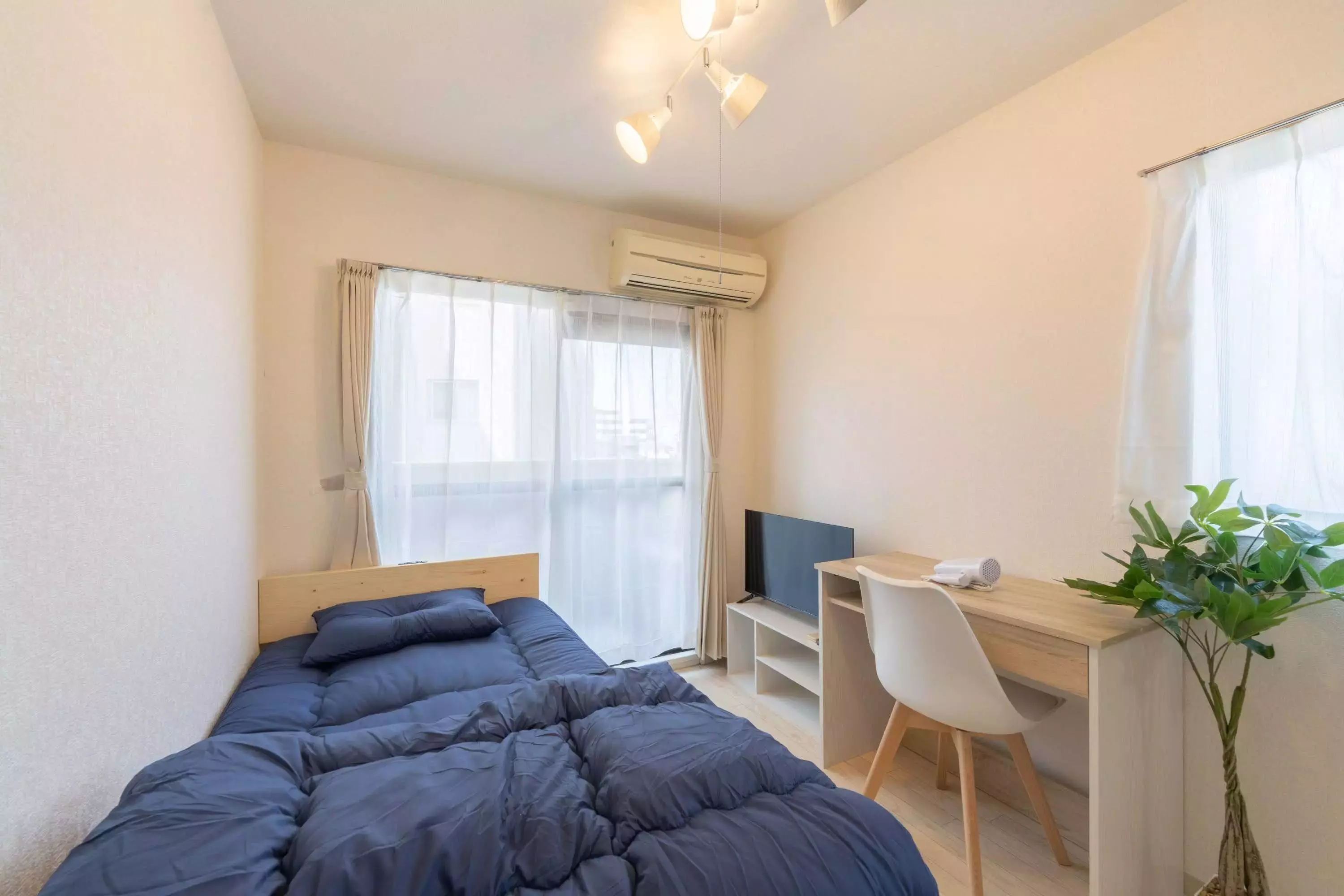
Our main product is the furnished apartment. Furniture and appliances are already in the room, so you can arrive with a suitcase and start working the next day instead of shopping for a bed, fridge and washing machine. Our homes are in major cities across Japan, including Tokyo, Osaka, Nagoya and Fukuoka. If your family will join you later, our spouse and dependent visa guide explains their side of the process.
Not sure which neighborhood to pick? Our Tokyo neighborhood guide compares areas by commute, budget and atmosphere, which helps once you know where the office will be.
What it costs to move in
A typical Japanese rental often asks for a deposit and key money of around one month's rent each, plus an agency fee, before you pay the first month. At XROSS HOUSE there is no deposit and no agency fee. The one-time move-in cost is our initial fee: ¥30,000 for a furnished apartment during the current campaign (normally ¥50,000).
Guarantor and guarantee company
- No personal joint guarantor is needed.
- Individual contracts generally require joining a rent guarantee company. An initial guarantee fee and a monthly guarantee fee are charged separately, on top of the initial fee.
- If you pay everything from the initial fee to the move-out costs in one lump sum at move-in, you do not need to join a guarantee company, so no guarantee fees apply.
Rent is paid in addition to the initial fee. Ask for a written quote before you sign. It lists every cost from move-in to move-out, including the monthly rent and common service fee and the cleaning fee at move-out, and the contract states the minimum stay and the notice period for leaving. Once your company is running, we can also discuss contracts in the company's name for you or for staff you bring to Japan.
FAQ: Business Manager visa in Japan
How much capital do I need for a Business Manager visa in Japan?
Since October 16, 2025, the criteria require capital or total investment of ¥30 million or more. The earlier ¥5 million level no longer meets the criteria on its own. Check the Immigration Services Agency page for the details of what counts.
Do I need to speak Japanese to get a Business Manager visa?
Either you or a full-time employee needs a considerable level of Japanese, such as JLPT N2 or a BJT score of 400 or more. Many founders meet this by hiring a full-time employee who has that level.
Can I use my apartment as my company office?
Under the amended criteria, using your home as the office is generally not accepted. Plan for a separate business premises and a separate place to live. Residential rentals, including XROSS HOUSE homes, are for living only and cannot serve as the registered office.
I already have a Business Manager visa. Will my renewal be refused?
Not automatically. For renewals until October 16, 2028, immigration looks at the overall situation, including whether the business is likely to meet the new criteria by the next renewal. After that, the new criteria apply. Talk with a gyoseishoshi or tax accountant early.
Can a foreign employee on a work visa be my full-time employee?
No. The full-time employee must live in Japan and hold a status without work restrictions, such as a Japanese national or a permanent resident. Employees on regular work visas do not count toward this requirement.
Where should I live while I set up my company in Japan?
A furnished apartment is a practical choice while the company and office are being set up. You can move in with a suitcase and choose a longer-term home once you know where the office will be. XROSS HOUSE can suggest areas near your planned office.
Do I need a guarantor to rent a furnished apartment as a new business owner?
At XROSS HOUSE, no personal joint guarantor is needed. Individual contracts generally join a rent guarantee company, unless you pay all costs from the initial fee to move-out in one lump sum at move-in. More answers are on our FAQ page.
Search for a room
Only furnished properties with appliances are listed!
Summary: plan the capital, the people and two addresses
The Business Manager visa is still open to founders, but the bar is much higher than before. Since October 16, 2025, you need ¥30 million in capital, at least one full-time employee, Japanese ability in the team, a relevant degree or management experience, and a business plan checked by a professional. If you already hold the visa, use the transition period until October 16, 2028 to prepare.
Plan your office and your home as two separate places. Tell us where your office will be, when you arrive and how long you expect to stay, and we will suggest areas and send a written quote.
This article gives general information based on official sources as of November 2026. It is not legal advice. For your own application, check the Immigration Services Agency page or ask a gyoseishoshi.