- Most degree students enter through the EJU or an English-taught program.
- National university fees follow a standard set by the government.
- Scholarships such as MEXT and JASSO can cover part of the cost.
- Arrange housing early, before your first term starts.
How international students get into Japanese universities
There is no single door. Japanese universities for international students offer several routes, and the right one depends on your language level, your goal and how long you plan to stay. Here are the four main ones.
| Route | Who it suits | Language of study |
|---|---|---|
| Japanese-taught degree (EJU-based) | Students who want the widest choice of schools and majors | Japanese |
| English-taught degree program | Students with strong English who are still learning Japanese | English |
| Exchange student (partner university) | Students already enrolled at a university in your home country | Japanese or English, depending on the course |
| Graduate school or research student | Students who already hold a bachelor's degree | Varies by lab and program |
Japanese-taught degrees and the EJU
Most undergraduate programs are taught in Japanese. Many universities use the Examination for Japanese University Admission for International Students (EJU) as part of selection, and some add their own exam or interview. You will normally need a good level of Japanese, so a year at a language school is a common first step. See our guides to Japanese language schools and the JLPT.
English-taught degree programs
A smaller number of universities offer full degrees taught in English. Admission usually relies on your high school record, English test scores and an application essay or interview, rather than the EJU. Each school sets its own requirements, so read the admission guidelines of every program you consider.
Exchange programs
If your home university has a partnership with a Japanese one, you can study in Japan for a term or a year while staying enrolled at home. Your international office handles the nomination, and a Japan exchange student usually pays tuition to the home university under the agreement. Ask your office what applies to you, because arrangements differ between schools.
Graduate school and research students
Graduate schools run their own admissions, often through a professor who agrees to supervise you. Some accept applicants as research students first, before a full master's or doctoral course. Start by contacting the lab that matches your field.
The numbers show how common this path has become. Japan hosted 408,069 international students as of May 1, 2025, up 21.2% from the year before and above 400,000 for the first time. Of these, 92,442 studied at undergraduate universities and 60,013 at graduate schools.
Source: JASSO, Result of International Student Survey in Japan, 2025 (as of May 2026)
The EJU explained
The EJU is an exam run by the Japan Student Services Organization (JASSO). It tests the academic ability and Japanese skills that universities want to see before you start. You can take it in Japan and in several other countries and regions.
- Japanese as a Foreign Language: reading, listening and writing.
- Science: physics, chemistry and biology.
- Japan and the World: history, geography and society.
- Mathematics: offered at two levels.
You do not take every subject. Each university and faculty decides which ones it requires, and some let you take parts of the exam in English. Check the admission guidelines of your target schools before you register.
The exam is held twice a year. In 2026 the sessions were on June 21 and November 8. The dates for next year are announced on the JASSO site.
Source: JASSO, EJU 2026 guide (as of November 2026)
A practical tip: many applicants take the June session so that the results are ready for fall and winter applications, and keep the November session as a second chance. Whichever session you choose, plan your application timeline backward from each school's deadline.
Search for a room
Only furnished properties with appliances are listed!
Tuition and costs at Japanese universities for international students
Fees depend mainly on whether the university is national, public or private. National universities charge a standard amount set by the government. Private universities cost more, and the gap grows for medicine, dentistry and pharmacy.
| Type | Approximate cost |
|---|---|
| National university: admission fee | ¥282,000 (standard amount) |
| National university: annual tuition | ¥535,800 (standard amount) |
| Private university: first-year total | Roughly ¥1,100,000 on average, excluding medicine, dentistry and pharmacy |
Source: Study in Japan, Academic Fees (as of November 2026)
These are approximate figures. Some national universities set tuition above the standard amount, so confirm the exact fees on each school's own site.
Living costs sit on top of tuition
Tuition is only part of the budget. Rent, food, transport and phone costs add up every month, and rent is usually the largest of them. Your housing choice therefore affects how far a scholarship or part-time income will go. Keeping your fixed costs low and predictable is one of the easiest ways to make a student budget work.
To find schools by region, field and language of instruction, use the official search tool on the Study in Japan site.
Source: Study in Japan, University Search (as of November 2026)
Scholarships for international students
Scholarships can reduce tuition, living costs or both. Three sources are worth checking first.
- MEXT scholarship (Japanese government): offered through Japanese embassies or directly through universities. Our MEXT scholarship guide explains the types and how to apply.
- JASSO scholarships: JASSO runs the Honors Scholarship for Privately Financed International Students for students who are already enrolled. Details and eligibility are on the JASSO site.
- University and local scholarships: many schools, cities and private foundations run their own programs. Ask the international office after you are admitted.
Deadlines and amounts change from year to year. Always read the current announcement, and apply to more than one program if the rules allow it.
Search for a room
Only furnished properties with appliances are listed!
Student visa and part-time work
A degree student normally needs a Student visa. Your university issues the documents that support the application, and the Immigration Services Agency decides on the visa. Our Japan student visa guide walks through the steps and the official sources.
Many students also want to earn some money. Permission from immigration is required before you start, and a weekly hour limit applies. We cover the rules, pay levels and typical jobs in our guide to part-time jobs in Japan.
Where international students live in Japan
You usually have three choices. Each suits a different student.
| Option | What it is like |
|---|---|
| University dormitory | Low cost, but places are limited and often go to first-year or exchange students only |
| Share house | A private room with shared kitchen and living areas. Good for a lower budget and for meeting people |
| Furnished apartment | Your own private space with furniture and appliances already in the room |
Dorms are worth applying for, but you should not count on a place. Ask your university early, and have a backup plan.
Over the years, more than 8,000 students, including international students, have lived in XROSS HOUSE homes. The question we hear most is not about rent but about location: how long the commute to campus will be. Before you compare rooms, check which train line your campus is on and look for homes along that line. A room 30 minutes away on a direct line is often easier to live with than a closer one that needs two transfers.
Furnished apartments from XROSS HOUSE
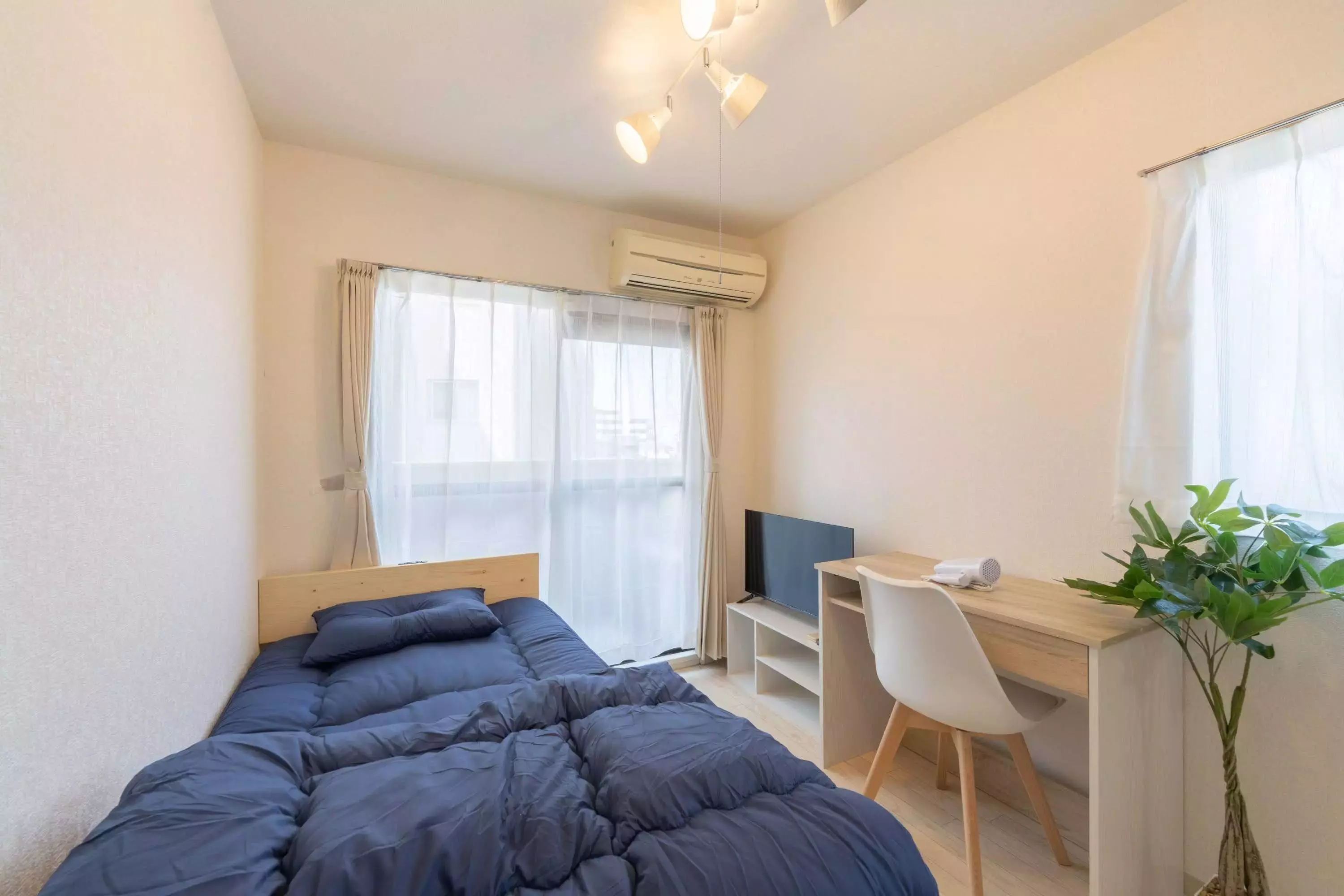
Our main product is the furnished apartment. Furniture and appliances are already in the room, so you can arrive with a suitcase and skip buying a bed, fridge or washing machine. That matters when you are moving from abroad and do not yet know how long you will stay.
Share houses as a budget option
XROSS HOUSE also has share houses. You get a private room and share the kitchen and living spaces with other residents. It is a good fit if you want a lower monthly cost and a ready-made community in a new country.
What it costs to move in
A typical Japanese rental often asks for a deposit and key money of around one month's rent each, plus an agency fee, before you pay the first month. At XROSS HOUSE there is no deposit and no agency fee. The one-time move-in cost is our initial fee: ¥30,000 for a share house, and ¥30,000 for a furnished apartment during the current campaign (normally ¥50,000).
Guarantor and guarantee company
- No personal joint guarantor is needed.
- Individual contracts generally require joining a rent guarantee company. An initial guarantee fee and a monthly guarantee fee are charged separately, on top of the initial fee.
- If you pay everything from the initial fee to the move-out costs in one lump sum at move-in, you do not need to join a guarantee company, so no guarantee fees apply.
Rent is paid in addition to the initial fee. Ask for a written quote that lists every cost from move-in to move-out before you sign.
Search for a room
Only furnished properties with appliances are listed!
FAQ: Japanese universities for international students
Do I need to speak Japanese to study at a Japanese university?
It depends on the program. Most undergraduate courses are taught in Japanese and expect a strong level. A smaller number of English-taught degree programs do not require Japanese for admission, though daily life is easier if you learn some.
What is the EJU and do all universities require it?
The EJU is an exam run by JASSO for international applicants. It is held twice a year, and each university decides whether and which subjects it requires. English-taught programs often use other criteria instead.
How much does a national university cost for international students?
The standard national university fees are an admission fee of ¥282,000 and annual tuition of ¥535,800. Some universities set tuition higher, so check each school's own fee table.
How does a Japan exchange student program work?
Your home university nominates you under a partnership agreement, and you study at the Japanese partner for a term or a year. Fees and credit transfer depend on the agreement, so ask your international office first.
Can I apply to a Japanese university while I am still abroad?
Many schools accept applications from overseas, especially for English-taught programs and for applicants who have taken the EJU in their own country or region. Procedures vary, so read each university's admission guidelines.
When should I look for housing as a new university student?
Start as soon as you receive your admission result. Rooms near campuses fill up before the spring and fall terms, so booking early gives you more choice. You can also arrange a place before you arrive in Japan.
Do I need a guarantor to rent a furnished apartment as a student?
At XROSS HOUSE, no personal joint guarantor is needed. Individual contracts generally join a rent guarantee company, unless you pay all costs from the initial fee to move-out in one lump sum at move-in. More answers are on our FAQ page.
Summary: pick your route, then plan your budget
Choose the route that matches your language level: EJU-based Japanese-taught programs, English-taught degrees, exchange or graduate study. Check each university's own requirements, compare tuition for national and private schools, and look at scholarships early. National university fees follow a standard amount, while private universities cost more.
Housing is the part you can settle early. Tell us your university, your arrival date and how long you plan to stay, and we will suggest areas and send a written quote.