What "Studio Apartment" Means in Japan
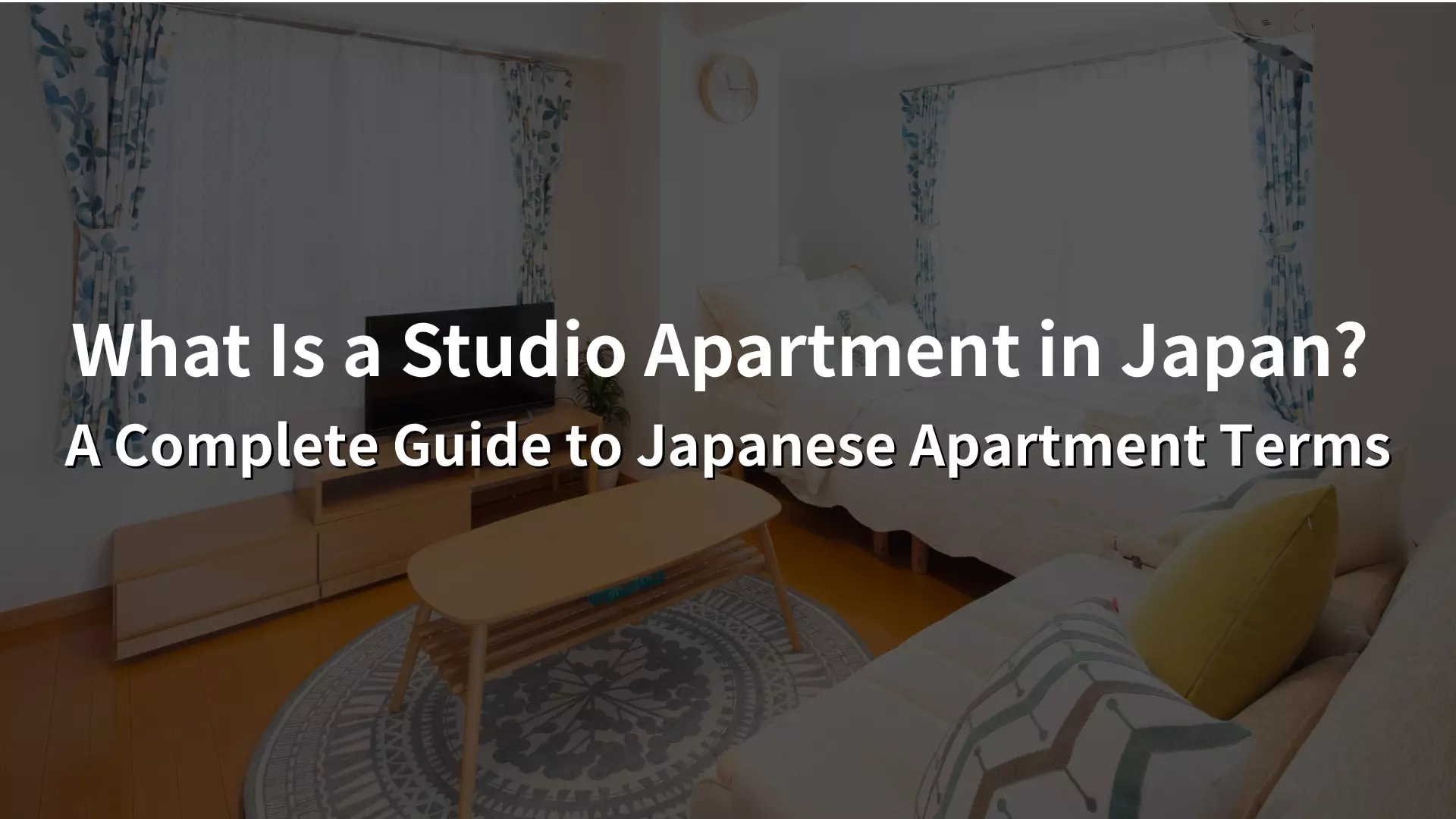
In American English, a studio apartment is a self-contained unit where the bedroom, living area, and kitchen share one open room — only the bathroom is separate. Japan has its own equivalent, but the terminology differs.
The closest Japanese equivalent to a studio apartment is a 1R (one room) or a 1K (one room with a separate kitchen). Depending on the real estate company, even a 1DK is sometimes described as a studio in English listings. Understanding which type fits your needs requires knowing exactly what each term includes — and what it leaves out.
How Japanese Apartment Classifications Work
What the Numbers Mean
The number at the beginning of a Japanese apartment code tells you how many rooms the unit contains, not counting the kitchen, dining area, bathroom, or toilet. A 1-bedroom apartment has one room. A 2-bedroom apartment has two rooms. Simple enough — but what matters most is the letters that follow.
What the Letters Mean
The letters describe what spaces exist beyond those numbered rooms:
- R — Room. The kitchen is part of the main room with no partition.
- K — Kitchen. A small kitchen that is physically separated from the main room.
- DK — Dining Kitchen. A kitchen large enough to also serve as a dining area.
- LDK — Living, Dining, Kitchen. A combined living, dining, and kitchen area that is separate from the bedroom.
So a 1LDK means: one bedroom plus a separate living-dining-kitchen space. A 1K means: one room plus a small separate kitchen.
Search for a room
Only furnished properties with appliances are listed!
Studio Apartment Types in Japan: 1R, 1K, and 1DK Explained
1R — The Most Compact Studio
A 1R (one-room) apartment is Japan's most compact living option. It is a true studio: the kitchen, sleeping area, and living space are all in a single open room, typically between 13 and 20 square meters in size. Only the bathroom is separate.
When you walk into a 1R apartment in Tokyo, you will usually find a small kitchen along one wall immediately at the entrance. Beyond that is the main living-sleeping space. There are no partitions.
1R apartments are best suited for single renters, students, or professionals who spend most of their time outside the apartment. Rent in Tokyo for a 1R unit typically ranges from ¥45,000 to ¥80,000 per month depending on the neighborhood and building age.
1K — One Room With a Separate Kitchen
A 1K apartment is one step up from the 1R. The K stands for kitchen, and it means there is a small, physically separated kitchen space — typically a corridor or small room of 4.5 square meters or less — that is distinct from the main room. This partition helps contain cooking smells and gives the main living area a cleaner feel.
1K units usually range from 18 to 30 square meters in total floor area. They are the most common entry-level apartment type in Japan and are popular with single professionals moving to Tokyo for work.
1DK — A Slightly Larger Studio Layout
In a 1DK apartment, DK stands for dining kitchen. The kitchen area is larger than in a 1K — large enough to fit a dining table, typically between 4.5 and 8 square meters. The main room is separate.
Total floor space in a 1DK usually runs from 25 to 35 square meters. This layout works well for renters who cook regularly and want a dedicated space to eat without being in the main bedroom.
Beyond Studios: 1LDK and Larger Apartments
1LDK — A True One-Bedroom With Living Space
A 1LDK is not a studio. It is Japan's equivalent of a one-bedroom apartment in American terms. The LDK area is a combined living room, dining room, and kitchen — large enough to serve as a proper social space — and it is completely separate from the one bedroom.
1LDK apartments range from about 30 to 50 square meters and are ideal for single professionals who want separate spaces for sleeping and relaxing, or for couples sharing a smaller apartment.
2LDK and Beyond
Larger layouts follow the same pattern: a 2LDK has two bedrooms plus a living-dining-kitchen space, a 3LDK has three bedrooms, and so on. These are suited for couples, families, or roommates who need more space and privacy.
Search for a room
Only furnished properties with appliances are listed!
How Size Is Measured in Japanese Apartments
Square Meters (㎡)
Most modern Japanese apartment listings display total floor area in square meters. This is the easiest measurement for international renters to understand. A small 1R might be 13㎡ while a large 1LDK can reach 45㎡.
Tatami Mats (畳 / 帖)
Older listings — and room sizes within apartments — are sometimes described in tatami mats (jo or jo). One tatami mat equals approximately 1.62 square meters, though the exact size varies slightly by region. Tokyo tatami mats are slightly smaller than those in Osaka or Kyoto. You may see a room described as 6畳 (6 tatami mats), which works out to roughly 9.7 square meters.
Types of Rental Properties in Japan
Apaato (アパート) — Budget-Friendly Apartments
An apaato is a low-rise apartment building, usually two or three stories, constructed from wood or light steel. These buildings tend to be older, more affordable, and common in residential neighborhoods. Sound insulation is generally weaker than in concrete buildings. Popular with students and younger renters looking for low-cost options.
Manshon (マンション) — Concrete Buildings
Despite the English word "mansion" suggesting something grand, a Japanese manshon is simply a concrete or reinforced concrete apartment building. Manshon units tend to be quieter, better insulated, and equipped with more modern amenities. They are generally more expensive than apaato.
Share Houses — A Popular Option for Foreigners in Tokyo
A share house is a furnished, all-inclusive rental property where tenants have their own private bedroom but share common spaces such as the kitchen, living room, and bathroom. Share houses have become a major option for international residents in Tokyo because they offer several advantages that traditional studio apartments cannot:
- No guarantor required (Japanese apartments often require a Japanese co-signer)
- Fully furnished from day one
- Utilities and Wi-Fi often included in a single monthly fee
- Built-in community and social connections
- Much lower upfront costs compared to renting a private apartment
XROSS HOUSE operates share houses across Tokyo with both Japanese and international residents. The properties are designed to provide a comfortable, modern living experience with clear communication in English — making them one of the easiest entry points into living in Tokyo.
Search for a room
Only furnished properties with appliances are listed!
What to Expect Inside a Studio Apartment in Japan
Bathroom Layout: Unit Bath vs. Separate
In many compact Japanese apartments, especially 1R and 1K units, the bathroom is a "unit bath" (ユニットバス) — a prefabricated molded unit combining the bathtub, toilet, and sink in a single space. Some renters find this layout inconvenient. Higher-end or larger apartments often feature a separate toilet room, which is a significant quality-of-life improvement.
Storage, Kitchen, and Living Space
Japanese studio apartments are designed with space efficiency in mind. Storage is often built into walls or located above the entrance area. Kitchen facilities in a 1R or 1K are typically a narrow two-burner gas or IH stove with minimal counter space. Living areas frequently double as bedrooms, with a futon or foldable mattress on the floor.
Privacy in Small Japanese Apartments
Privacy in compact Japanese units depends heavily on the building type and construction era. Older apaato buildings have thin walls and minimal sound insulation, meaning you can often hear neighbors. Newer manshon buildings offer substantially more privacy. If privacy is a priority, a newer concrete building — or a share house with a private room — will provide a better experience than an older wood-framed apaato.
Common Mistakes Foreign Renters Make in Japan
Many international renters discover too late that renting a private apartment in Japan involves significant hurdles. The most common issues include:
- No guarantor: Most apartments require a Japanese guarantor (hoshounin). Foreigners without a Japanese contact face automatic rejections.
- High upfront costs: Traditional Japanese apartments require key money (reikin), a security deposit (shikikin), and real estate agent fees — often totaling 4-6 months of rent paid before moving in.
- Unfurnished units: Most Japanese apartments come completely empty, including no appliances or light fixtures.
- Language barriers: Lease agreements and agency communications are in Japanese.
Understanding these realities before you start searching helps you set realistic expectations and choose the right type of accommodation.
Is a Studio Apartment Right for You in Tokyo?
Who Should Consider a 1R or 1K
A 1R or 1K apartment works well if you are a single professional or student with a small budget, you spend most of your time outside the apartment, you already have a Japanese guarantor or are using a guarantor service, and you do not mind furnishing the space yourself. These small apartments are common throughout Tokyo and can be found in nearly every neighborhood at a range of price points.
Share Houses as an Alternative to Studio Apartments
For most foreigners arriving in Tokyo — especially for the first time — a share house is a more practical starting point than a private studio apartment. The lower upfront costs, included furniture and utilities, and English-speaking support remove the most stressful barriers to housing in Japan.
Once you are settled, understand the city, and have built the practical requirements (bank account, guarantor access, Japanese language skills) for a private lease, transitioning to a private 1K or 1DK becomes much easier.
XROSS HOUSE provides share house options throughout Tokyo that are specifically designed to be accessible for international residents. Whether you are looking for your first home in Japan or a comfortable base while you explore the city, a share house removes many of the barriers that make renting in Japan difficult.