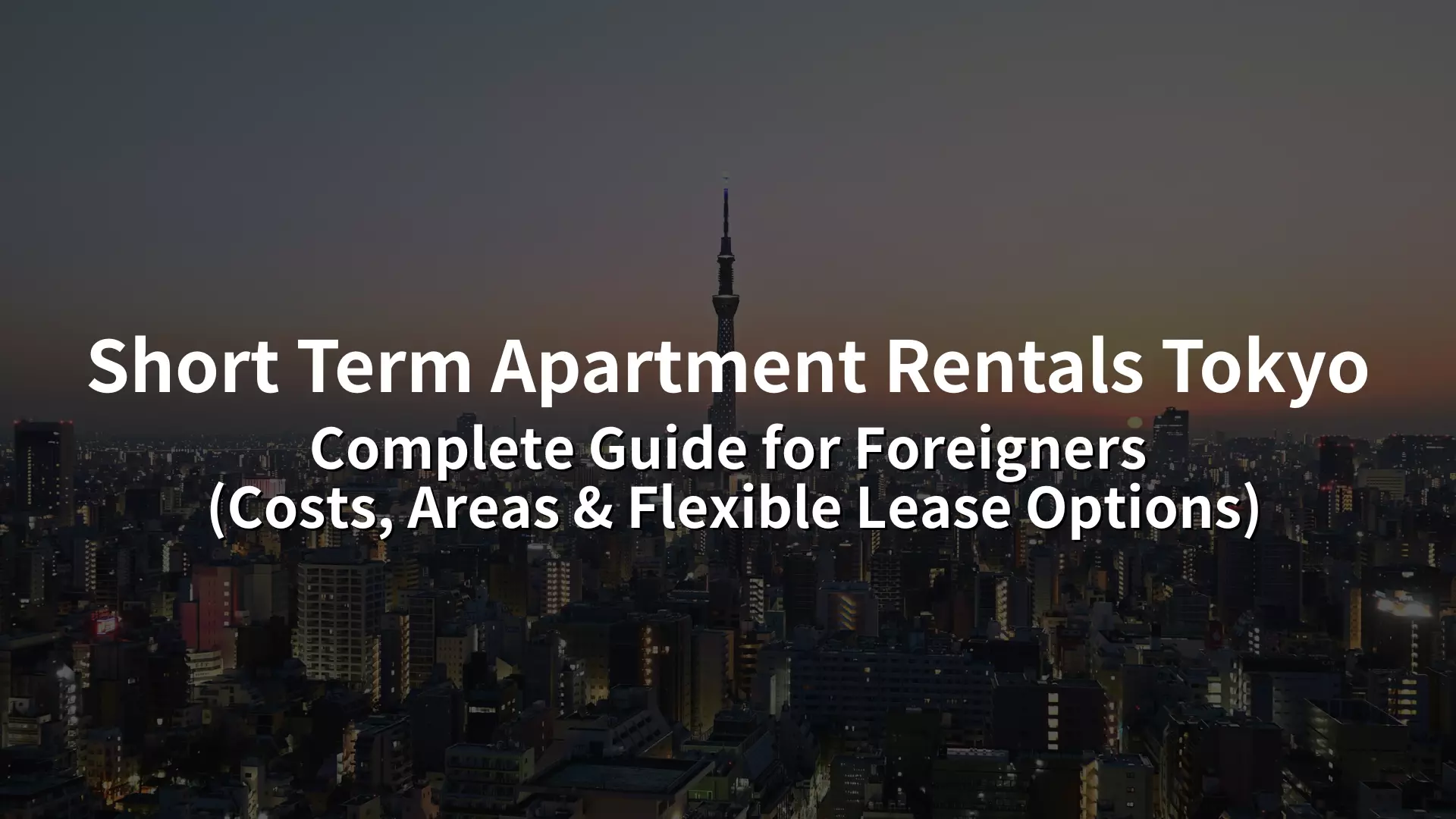
What Are Short Term Apartment Rentals in Tokyo?
Short term apartment rentals in Tokyo are fully furnished or semi-furnished residential units available for stays ranging from one month to about a year. Unlike traditional Japanese apartments, which typically require two-year lease agreements, these rentals offer flexible contract terms designed for people who need temporary housing in the city.
In Japan's rental market, the term "short term" generally refers to any lease shorter than the standard two-year contract. This includes monthly apartments (known as mansuri mansion in Japanese), serviced apartments, furnished rentals, and share houses—all of which cater to residents who don't plan to stay permanently.
How They Differ from Standard Apartments in Japan
A standard apartment rental in Tokyo usually involves significant upfront costs: a security deposit (typically one to two months' rent), non-refundable key money (reikin), an agent fee, and a guarantor company fee. The total initial cost for a regular rental often adds up to four to six months' worth of rent before you even move in. Short term rentals simplify this process dramatically. Most properties come fully furnished with a bed, desk, refrigerator, microwave, and washing machine. Many also include Wi-Fi, and some bundle utilities into the monthly rent. Initial costs are far lower—sometimes just a single registration fee—making them accessible to newcomers who haven't yet established a life in Japan.
Short term apartment rentals are especially popular among foreigners in Tokyo because the application process is typically simpler, English support is more readily available, and no Japanese guarantor is required.
Who Provides Short Term Rentals in Tokyo?
The short term rental market in Tokyo is served by a variety of companies. Large share house operators like XROSS HOUSE and Oakhouse manage thousands of rooms across the city. Serviced apartment brands like Blueground and Hmlet target higher-budget professionals. Monthly mansion operators such as TokyoMonthly21 and At-Inn offer self-contained furnished units. Online listing platforms like GaijinPot Apartments and Real Estate Japan aggregate properties from multiple providers, making it easier to search and compare options in different areas of the city. Each provider has its own pricing model, contract terms, and level of English support, so comparing several options is always recommended before committing.
Why Choose a Short Term Apartment Instead of a Hotel in Tokyo?
Hotels in Tokyo are convenient for a week-long trip, but staying in a hotel for a month or longer becomes expensive fast. Even a modest business hotel in Shinjuku or Shibuya costs ¥8,000–¥15,000 per night, which adds up to ¥240,000–¥450,000 per month—far more than most short term apartment rentals.
Beyond cost, there are practical reasons to choose an apartment over a hotel for an extended stay in Tokyo.
Space and Privacy
A typical Tokyo hotel room offers 15–20 square meters with minimal storage. A short term apartment or share house private room gives you a dedicated living space where you can cook, work, and relax without the constraints of hotel living. Having your own kitchen means you can prepare meals at home—a major money saver in a city where even a simple lunch can cost ¥800–¥1,200.
A More Authentic Living Experience
Staying in an apartment lets you experience Tokyo the way residents do. You'll shop at local supermarkets, learn to navigate the train system from your nearest station, and discover the hidden restaurants and coffee shops in your neighborhood. This kind of everyday immersion simply isn't possible from a hotel in a tourist district.
Work-Friendly Environment
For remote workers, digital nomads, and business professionals, an apartment provides a stable workspace with reliable Wi-Fi and a quiet room. Many short term properties are located close to major train stations, making it easy to commute to meetings or explore different areas of the city during your stay.
Community and Social Connections
If you choose a share house, you'll gain something hotels simply cannot offer: a built-in social network. Living alongside other residents—many of them fellow foreigners, students, and young professionals—creates natural opportunities to make friends, share travel tips, and explore Tokyo together. This social aspect is particularly valuable if you're moving to Japan alone and want to avoid the isolation that can come with living in a hotel room for weeks or months.
Search for a room
Only furnished properties with appliances are listed!
Types of Short Term Rentals in Tokyo (Serviced, Monthly, Furnished & Share Houses)
Tokyo's short term rental market offers several distinct housing categories, each with different price points, amenities, and lease terms. Understanding the differences will help you choose the right option based on your budget, lifestyle, and length of stay.
Serviced Apartments
Serviced apartments are the premium tier of short term housing in Tokyo. These fully furnished units come with hotel-like amenities including regular cleaning, concierge services, and sometimes even a front desk. Properties are typically located in prime areas such as
Minato, Shibuya, and Chiyoda wards.
Monthly rent for a serviced apartment ranges from ¥200,000 to over ¥1,000,000 depending on location and size. They're ideal for business executives, corporate transfers, and anyone who values convenience and is willing to pay a premium. Utilities, Wi-Fi, and building services are usually included in the monthly fee.
Monthly Furnished Apartments
Monthly apartments (also called monthly mansions) are standard residential units rented on a month-to-month basis. They come furnished with essential furniture and appliances, and residents handle their own cooking, cleaning, and daily routines—just like in a regular apartment.
Rent typically falls between ¥80,000 and ¥200,000 per month for a studio or one-bedroom unit in central Tokyo. Most require a minimum stay of one month, and contract terms are straightforward. This type of rental is popular among professionals on temporary assignments, students settling into Tokyo before finding long-term housing, and families relocating to Japan.
Furnished Apartments with Appliances
Some housing companies offer regular apartments that come pre-equipped with furniture and appliances but operate on rental terms closer to traditional leases—though still more flexible. XROSS HOUSE, for example, offers furnished apartments starting from ¥60,000 per month with initial costs of only ¥50,000 (no deposit, no key money, no agent fee). Residents sign their own contracts for utilities like water, electricity, and gas, similar to a standard rental.
This option bridges the gap between a monthly mansion and a regular apartment, offering lower rent than serviced properties while still eliminating the hassle of buying furniture.
Share Houses
Share houses are a unique and increasingly popular housing option in Tokyo, especially among foreigners, students, and young professionals. In a share house, you rent your own private bedroom while sharing common areas like the kitchen, living room, bathrooms, and laundry facilities with other residents.
Share houses are by far the most affordable short term rental option in Tokyo. Private rooms start from as low as ¥30,000 per month, and semi-private rooms (where a larger room is divided by a partition) are even cheaper. Many share houses include utilities and Wi-Fi in the rent, keeping monthly costs predictable and low.
Beyond the financial benefits, share houses offer a social living experience. You'll meet people from different countries and backgrounds, making them especially appealing if you're new to Japan and want to build a community quickly. Companies like XROSS HOUSE operate over 6,500 rooms across Tokyo, with properties in popular areas such as Shinjuku, Shibuya, Ikebukuro, and Asakusa.
How Much Do Short Term Apartment Rentals in Tokyo Cost?
Cost is one of the most important factors when choosing short term housing in Tokyo. Prices vary significantly depending on the type of rental, location, room size, and what's included in the monthly fee. Below is a general breakdown to help you plan your budget.
Monthly Rent by Property Type
The following price ranges reflect typical costs for short term rentals across central Tokyo and surrounding areas:
Serviced apartments command the highest rents, generally ¥200,000–¥500,000 or more per month for a studio or one-bedroom unit in areas like Roppongi, Azabu, or Akasaka. These prices include furnishings, utilities, cleaning, and concierge services.
Monthly furnished apartments are more affordable, typically ranging from ¥100,000–¥250,000 per month. A compact studio near a major station like Shinjuku or Shibuya might cost around ¥120,000–¥180,000, while properties in quieter residential areas can be found for under ¥100,000.
Furnished apartments with appliances through providers like XROSS HOUSE start from approximately ¥60,000–¥80,000 per month, making them one of the most cost-effective private living options in Tokyo.
Share house private rooms range from ¥30,000–¥70,000 per month depending on location and room size. Semi-private and dormitory-style rooms are available from around ¥25,000–¥40,000.
Initial Costs and Move-In Fees
Traditional Tokyo apartments require initial costs totaling four to six months' rent. Short term rentals dramatically reduce this barrier. For a share house or furnished apartment through XROSS HOUSE, the initial cost is just ¥30,000–¥50,000 (registration fee only), with zero deposit, zero key money, and zero agent fee. Most monthly apartments charge a contract fee of one month's rent plus an administration fee.
Hidden Costs to Watch For
When comparing properties, pay attention to additional monthly charges that may not be included in the advertised rent. Common extras include a utility fee (¥10,000–¥15,000 if not bundled), internet charges, building maintenance fees, and cleaning fees upon move-out. Some companies also charge a contract renewal fee if you extend your stay beyond the initial term. At XROSS HOUSE, for example, there is a flat utility fee of ¥10,000 per month for share houses (which covers electricity, gas, water, and Wi-Fi), a system fee for customer support, and a contract renewal fee of ¥11,000 per year.
Search for a room
Only furnished properties with appliances are listed!
Best Areas in Tokyo for Short Term Apartment Rentals
Choosing the right area in Tokyo depends on your priorities: proximity to work, access to nightlife and restaurants, a quieter residential atmosphere, or simply getting the lowest rent possible. Here are some of the most popular areas among foreigners renting short term in Tokyo.
Shinjuku
Shinjuku is one of Tokyo's largest transportation hubs, with access to JR lines, Tokyo Metro, and private railways. The area around Shinjuku Station is lively, with endless shopping, dining, and entertainment options. Short term rentals here tend to be pricier, but the convenience of the location is hard to beat for business travelers and anyone who wants to be in the center of the action. Many share houses and furnished apartments are available in the neighborhoods surrounding the station.
Shibuya
Known for its iconic scramble crossing and vibrant youth culture, Shibuya is a popular district for young professionals and creative workers. The area offers excellent train access, plenty of cafes for remote work, and a thriving social scene. Rent in Shibuya is among the highest in Tokyo, but nearby residential streets offer slightly more affordable short term options while keeping you close to everything.
Ikebukuro
Ikebukuro provides many of the same urban conveniences as Shinjuku and Shibuya but at lower price points. It's a major transit hub on the Yamanote Line with plenty of shopping centers, restaurants, and entertainment. The area is particularly popular among international residents and has a growing number of share houses and furnished rentals targeting foreigners.
Asakusa and Ueno
For those who want to experience traditional Tokyo, Asakusa and the surrounding Ueno area offer a cultural atmosphere that's very different from the modern hubs of Shinjuku and Shibuya. These areas have lower rent, easy access to popular tourist spots like Senso-ji Temple and Ueno Park, and a growing number of foreigner-friendly properties. Train access to central Tokyo is convenient via the Ginza and Asakusa Metro lines.
Outer Wards and Suburban Areas
If budget is your primary concern, neighborhoods in Suginami, Nerima, Edogawa, and even cities just outside Tokyo like Machida or parts of Yokohama offer significantly lower rent while remaining accessible by train. A private room in a share house in these areas can cost as little as ¥30,000–¥40,000 per month—roughly half of what you'd pay in Shinjuku or Shibuya. XROSS HOUSE operates properties across many of these areas, giving residents the flexibility to choose a location that fits both their budget and commuting needs.
Shinagawa and Ota Ward
Shinagawa is a major transportation hub with Shinkansen (bullet train) access, making it ideal for business travelers who need to commute to Osaka, Kyoto, or other cities outside Tokyo. The area around Shinagawa Station has undergone significant redevelopment and offers a mix of modern office buildings and residential neighborhoods. Rent is moderate compared to Shibuya or Minato, and the convenient train access makes it popular with professionals. Several share houses and furnished apartments are available within walking distance of the station.
Nakano and Koenji
Located just a few stops west of Shinjuku on the JR Chuo Line, Nakano and Koenji are beloved by locals for their relaxed atmosphere, affordable restaurants, and vibrant shopping streets. These neighborhoods offer a more authentic, lived-in feel compared to Tokyo's flashier districts, and rent is noticeably lower. For foreigners who enjoy exploring local culture and don't mind a ten-minute train ride to central Tokyo, these areas represent excellent value for short term living.
Minimum Stay Rules & Lease Terms in Tokyo
Understanding Japan's short term rental regulations is important before you book. The rules differ depending on the type of property.
The Minpaku (Home-Sharing) Law
Japan's minpaku law, which governs private home-sharing and vacation rentals (including many Airbnb listings), limits stays to a maximum of 180 days per year per property. This law was introduced in 2018 to regulate the rapid growth of unlicensed vacation rentals. Properties operating under this framework typically offer nightly or weekly stays but are not considered traditional "apartments."
Monthly and Short Term Lease Minimums
Most short term apartments and share houses in Tokyo require a minimum stay of one month. This is because properties operating as regular residential rentals (rather than hotels or minpaku) follow Japan's tenancy laws, which establish monthly contracts as the shortest standard lease period.
Some serviced apartments and monthly mansions may offer slightly shorter stays of two weeks, but these come with higher daily rates. For a share house like XROSS HOUSE, the minimum length of stay is one month, and you can extend on a month-to-month basis without committing to a long lease. This flexibility is ideal for people who aren't sure how long they'll be staying in Tokyo.
Fixed-Term vs. Open-Ended Contracts
Short term rentals in Tokyo generally use one of two contract types. A fixed-term contract specifies an exact move-out date and doesn't automatically renew—you must negotiate a new contract if you want to stay longer. An open-ended (or rolling) contract continues month-to-month until either you or the landlord gives notice. Share houses and many furnished apartments use rolling contracts, giving tenants maximum flexibility.
Notice Periods and Early Termination
When you decide to leave, most short term rental contracts require advance notice—usually 30 days before your intended move-out date. If you leave without giving proper notice, you may be charged an additional month's rent or a cancellation fee. Some providers have shorter notice periods, so always confirm this detail before signing. Planning ahead and communicating clearly with your property management company will help you avoid unnecessary charges and ensure a smooth departure.
Search for a room
Only furnished properties with appliances are listed!
Can Foreigners Rent Short Term Apartments in Tokyo?
Yes—foreigners can absolutely rent short term apartments in Tokyo, and the process is generally much easier than renting a traditional apartment in Japan. However, there are some important things to know.
Visa Requirements
Your visa status affects what kind of rental you can access. If you're in Japan on a tourist visa, you can stay in hotels, Airbnb-style minpaku rentals, and some monthly apartments that don't require a residence card. However, most standard rental contracts—including many share houses and furnished apartments—require a valid residence card (zairyu card), which means you need a work visa, student visa, working holiday visa, or other long-term residence status.
Some short term rental companies are more flexible with visa requirements than others. XROSS HOUSE, for example, is designed to be foreigner-friendly and accepts applications from international residents with various visa types.
The Guarantor Issue
One of the biggest obstacles for foreigners renting in Japan is the guarantor (hoshounin) requirement. Traditional landlords often demand a Japanese guarantor—someone who will take financial responsibility if the tenant fails to pay rent. Most foreigners in Tokyo don't have a Japanese contact willing to serve as a guarantor.
Short term rentals largely eliminate this barrier. Share houses, monthly apartments, and furnished apartment providers typically don't require a personal guarantor. Some may use a guarantor company (at an additional cost), but many—including XROSS HOUSE—handle everything in-house without a guarantor requirement at all.
Language Barriers
While many property listings and landlord communications in Japan are in Japanese only, the short term rental market has adapted significantly to serve international residents. Major share house operators and furnished apartment companies offer English-language websites, English support via email, phone, LINE, WhatsApp, and other messaging apps, and online contract processes that can be completed without visiting a physical office.
Documents Required to Rent a Short Term Apartment in Tokyo
The paperwork required for a short term rental is much lighter than for a traditional Japanese apartment. Here's what you'll typically need.
For Residents with a Visa
If you already have a valid visa and residence card, most short term rental companies will ask for your passport (identification), your residence card (zairyu card), proof of income or employment (sometimes), and an emergency contact (doesn't need to be in Japan for many providers).
For Tourists or Pre-Arrival Applicants
If you haven't arrived in Japan yet, or if you're on a tourist visa, options are more limited but still available. Monthly apartments and some share houses accept applications with just a passport copy. You may be able to complete the entire application online, sign the contract digitally, and arrange a move-in date before you land in Tokyo.
XROSS HOUSE allows the entire contract process to be completed online using a smartphone, which is particularly convenient for people applying from overseas.
What You Won't Need
Unlike a standard Japanese rental, short term apartment rentals generally do not require a Japanese guarantor, a hanko (personal seal), a Japanese bank account (credit card payment is often accepted), or proof of long-term employment in Japan. This simplified documentation process is one of the key reasons short term rentals are so attractive to foreigners who are new to Japan or staying for a limited time. The reduced paperwork also means faster approvals—many applications are processed within a few days, compared to the weeks-long screening process for traditional Japanese apartments.
What's Included? Furniture, Utilities, Wi-Fi & Hidden Costs Explained
One of the main advantages of short term rentals in Tokyo is that they come furnished, but the extent of what's included varies by property type.
Standard Furniture and Appliances
Most furnished apartments and share house rooms include a bed (or futon), a desk and chair, a small closet or storage unit, a refrigerator, a microwave, and a washing machine (often shared in share houses, private in apartments). Higher-end properties may also include a TV, cookware, dishes, and linens.
Utilities and Wi-Fi
In share houses, utilities (electricity, gas, water) and Wi-Fi are frequently bundled into a flat monthly fee. At XROSS HOUSE share houses, for example, the flat utility fee is ¥10,000 per month, which covers all basic utilities plus free Wi-Fi access. This makes budgeting simple—you know exactly what you'll pay each month.
For furnished apartments, residents typically handle their own utility contracts, just like a regular rental. This means setting up accounts with Tokyo Electric Power (TEPCO), a gas provider, and the local water bureau. Internet may need to be arranged separately as well, though some buildings have existing connections.
Common Hidden Costs
Before signing any contract, check whether the following fees apply: a move-out cleaning fee (common, ranging from ¥15,000–¥30,000), a contract renewal fee if you stay beyond the initial term, a cancellation fee if you leave before the minimum stay period, a key replacement fee if you lose your key, and any charges for bedding sets, kitchen items, or other optional amenities.
Reading the full contract and asking about every fee line is the best way to avoid surprises.
Short Term Apartments vs Airbnb vs Hotels in Tokyo
Each accommodation option in Tokyo has strengths and weaknesses depending on your length of stay, budget, and needs. Here's how they compare.
Short Term Apartments and Share Houses
These are the best option for stays of one month or longer. They offer the lowest per-month cost, a real living experience with a kitchen and personal space, and flexible lease terms. The trade-off is that you need to handle your own cooking and cleaning, and the initial setup (even if minimal) takes more effort than checking into a hotel.
Airbnb and Vacation Rentals
Airbnb is convenient for stays of a few days to a few weeks. Properties range from private rooms to entire apartments, and booking is simple. However, under Japan's minpaku law, many listings are only available for limited periods, and pricing for a full month often exceeds what you'd pay for a furnished apartment. Quality and reliability can also vary significantly between hosts.
Hotels
Hotels offer maximum convenience—no paperwork, no setup, daily housekeeping—and are ideal for stays under two weeks. For longer stays, they become prohibitively expensive. Even budget business hotels in areas like Ikebukuro or Ueno cost ¥6,000–¥10,000 per night, translating to ¥180,000–¥300,000 per month for a small room with no kitchen.
For most foreigners planning to stay in Tokyo for a month or more, a short term apartment or share house provides the best balance of cost, comfort, and convenience.
Quick Comparison Table
When making your decision, consider the following general comparison across the three main accommodation types in Tokyo. Hotels are best for stays under two weeks, with no paperwork required and daily cleaning included, but at the highest nightly cost and with no kitchen or living space. Airbnb and vacation rentals work well for stays of a few days to a month, offering a range of property types at moderate prices, though availability may be limited under Japan's minpaku rules. Short term apartments and share houses are the clear winner for stays of one month or longer: they offer the lowest monthly cost, a fully furnished living space with kitchen access, flexible contracts, and the chance to experience Tokyo like a local resident.
The key takeaway is that the longer your stay in Tokyo, the more sense it makes to rent a short term apartment rather than book nightly accommodation. Even for a one-month stay, the difference in total cost between a hotel and a furnished apartment can be ¥100,000 or more.
How to Find and Secure a Short Term Apartment in Tokyo (Step-by-Step)
Finding the right short term rental in Tokyo doesn't have to be complicated. Follow these steps to streamline the process.
Step 1: Define Your Needs
Before you start your search, decide on your budget (including all monthly costs, not just rent), your preferred area or areas in Tokyo, your minimum room size and whether you want a private apartment or shared living, your required move-in date, and your expected length of stay.
Step 2: Search Online Platforms
Use English-language platforms that specialize in foreigner-friendly rentals. Popular options include XROSS HOUSE (share houses and furnished apartments across Tokyo), GaijinPot Apartments, Real Estate Japan, Wagaya Japan, and Fontana Apartments. Visit the websites directly, filter by your criteria, and shortlist properties that match your needs.
Step 3: Contact the Property or Company
Reach out to the company via email, their inquiry form, or messaging apps. Ask about availability, confirm all costs (rent, utilities, fees), and clarify the lease terms. Most foreigner-friendly companies respond in English within one to two business days.
Step 4: Submit Your Application
Provide the required documents—typically a passport copy and residence card (if applicable). Some companies let you complete the entire process online, including signing the contract digitally.
Step 5: Pay Initial Costs and Schedule Move-In
Once your application is approved, pay the initial fees (registration fee, first month's rent, etc.) and confirm your move-in date. For furnished properties, you can often move in with just your suitcase—all furniture and basic appliances are already in place.
Step 6: Arrive and Settle In
Pick up your keys (or receive access instructions), move into your room, and start your life in Tokyo. Share houses and furnished apartments allow you to settle in immediately without shopping for furniture or waiting for utility setup.
Common Problems Foreigners Face When Renting Short Term in Tokyo
Even with the relatively simple process of short term rentals, foreigners in Tokyo encounter some recurring challenges.
Language Barriers in Daily Life
While the contract process may be available in English, day-to-day interactions with neighbors, utility companies, and local services often require Japanese. In a share house, other residents may not speak English fluently. Having a translation app on your phone and learning basic Japanese phrases will make your experience significantly smoother.
Smaller Room Sizes Than Expected
Tokyo apartments are compact by Western standards. A "private room" in a share house might be 6–10 square meters (roughly 65–110 square feet), and a studio apartment could be 15–25 square meters. Check the floor plan and room dimensions carefully before booking, and look for 360-degree photos or virtual tours if available. XROSS HOUSE provides panoramic room photos on each property page, which helps set realistic expectations before you move in.
Noise and Shared Living Challenges
In a share house, you're living with other people, which means shared kitchen schedules, different cleanliness standards, and occasional noise. House rules exist to manage these issues, but some adjustment is always needed. If privacy and quiet are essential to you, a furnished apartment may be a better fit than shared living.
Difficulty Receiving Mail and Packages
Some short term rental addresses may not be compatible with certain delivery services, or you may face issues receiving packages if your name isn't registered on the mailbox in Japanese. Confirm mail procedures with your property management upon move-in.
Contract Misunderstandings
Always read the full terms of your contract, even if it feels tedious. Key things to verify include the exact move-out date or notice period required, whether the cleaning fee is mandatory, what the cancellation or early termination penalty is, and whether you're responsible for restoring the room to its original condition.
Discrimination in the Rental Market
Unfortunately, some landlords in Japan still refuse to rent to foreigners—studies have shown that nearly 40% of foreign residents in Japan have experienced some form of rental discrimination. This is far less common in the short term rental market, particularly with share house operators and furnished apartment companies that specifically cater to international residents. Companies like XROSS HOUSE, Oakhouse, and other foreigner-friendly providers have built their business models around serving international tenants, so discrimination is not an issue when working with these companies.
Understanding Japanese Address Systems
Japanese addresses work differently from Western address systems. Instead of street names and numbers, addresses in Tokyo use a hierarchical system of ward (ku), district (cho or machi), block (chome), sub-block, and building number. This can make finding your apartment confusing at first, and giving directions to taxi drivers or delivery services may require some practice. Save your address in Japanese on your phone, and use map apps like Google Maps, which handles Japanese addresses well.
Tips to Save Money on Short Term Apartment Rentals in Tokyo
Living in Tokyo doesn't have to drain your savings. Here are practical strategies to keep housing costs low during your short term stay.
Choose a Share House Over a Private Apartment
The single biggest way to save money on housing in Tokyo is to opt for a share house instead of a private apartment. A private room in a share house in a mid-range area costs ¥40,000–¥60,000 per month, while a comparable studio apartment would cost ¥80,000–¥120,000 or more. The trade-off is shared facilities, but the savings are substantial.
Look Beyond Central Tokyo
Areas like Nerima, Suginami, Adachi, and Machida offer rents that are 30–50% lower than Shinjuku, Shibuya, or Minato. As long as you're near a train station with good access to central Tokyo, the commute is manageable and the cost savings are worth it.
Take Advantage of Zero-Deposit Properties
Providers like XROSS HOUSE eliminate deposit, key money, and agent fees entirely. This means your initial move-in cost is just the registration fee (¥30,000 for share houses, ¥50,000 for apartments), saving you potentially hundreds of thousands of yen compared to a traditional rental.
Bundle Utilities When Possible
Properties that include utilities and Wi-Fi in the monthly rent help you avoid surprise bills and make budgeting straightforward. Compare the total monthly cost (rent + utilities + fees) rather than just the base rent when evaluating properties.
Cook at Home
Having access to a kitchen—whether private or shared—lets you cook your own meals, which can save ¥30,000–¥50,000 or more per month compared to eating out for every meal. Tokyo's supermarkets offer high-quality ingredients at reasonable prices, and the city's convenience stores (konbini) also sell affordable prepared foods.
Use Internal Transfer Options
Some share house companies, including XROSS HOUSE, allow you to transfer between properties at no additional cost. If you move to Tokyo and realize your first location isn't ideal, you can relocate to a different property in a more convenient area—like switching from Shibuya to Shinagawa—without paying a new registration fee or going through a full application process again.
Time Your Move Strategically
Tokyo's rental market has seasonal patterns. The busiest (and most expensive) time for housing is March and April, when the Japanese fiscal year begins and millions of people relocate for work or school. If you can time your arrival for May through January, you may find more availability and potentially better deals, as companies try to fill vacant rooms during off-peak months.
Consider Semi-Private or Dormitory Rooms
If you're on a tight budget and don't mind sharing space, semi-private rooms (where a larger room is split by a partition) and dormitory-style rooms with bunk beds offer the lowest rents available—sometimes as low as ¥25,000–¥35,000 per month. These room types still give you a bed, storage, and access to all shared facilities, making them a viable option for budget-conscious students and working holiday visa holders.
Use Free Community Amenities
Many share houses offer common areas where you can work, socialize, and relax without spending money going out. Some properties have shared books, entertainment systems, and outdoor spaces. Taking advantage of these free amenities helps reduce your overall cost of living in Tokyo.
Who Should Choose a Short Term Apartment in Tokyo?
Short term apartment rentals in Tokyo serve a wide range of people with different needs. Here's who benefits most from this type of accommodation.
Business Professionals and Corporate Transfers
If your company is sending you to Tokyo for a project lasting one to twelve months, a short term rental provides a comfortable and cost-effective home base. You get a stable living environment, a workspace-friendly room, and easy access to Tokyo's business districts—without committing to a two-year lease.
International Students
Students coming to Tokyo for language school, university exchange programs, or research projects often need housing for three to twelve months. Share houses are especially popular with students because of the low cost, social atmosphere, and minimal paperwork. Many share house residents are fellow students and young professionals, creating a natural community.
Remote Workers and Digital Nomads
Tokyo is an increasingly popular destination for remote workers who want to experience life in Japan while maintaining their careers. A furnished apartment or share house with reliable Wi-Fi offers the stability and comfort needed for productive remote work, all at a fraction of the cost of hotel living.
People in Life Transitions
Whether you're relocating to Japan and need temporary housing while searching for a permanent home, going through a divorce, or between jobs, short term rentals provide a low-commitment place to stay while you figure out your next step.
Tourists on Extended Visits
If you're planning to explore Tokyo and the surrounding areas of Japan—perhaps visiting Kyoto, Osaka, and other cities as well—a short term apartment gives you a home base at a much lower cost than a hotel. As long as your stay meets the minimum contract period (usually one month), this is one of the smartest ways to enjoy an extended trip.
Working Holiday Visa Holders
Young adults in Tokyo on working holiday visas often stay for six months to a year. Share houses are ideal for this group: affordable, flexible, and social. Around 10% of residents at many Tokyo share houses are working holidayers, making it easy to connect with people in similar situations.
Why XROSS HOUSE Is a Smart Choice for Short Term Apartment Rentals in Tokyo
Among the many housing providers in Tokyo, XROSS HOUSE stands out as one of the most practical options for foreigners seeking short term accommodation. Here's why.
Massive Property Network
XROSS HOUSE operates over 6,500 rooms across Tokyo, including locations in Shinjuku, Shibuya, Ikebukuro, Asakusa, Ueno, and many other popular areas. Whether you want to live in the heart of the city or prefer a quieter residential neighborhood, there's likely a XROSS HOUSE property nearby. The company offers both share house rooms and furnished private apartments, so you can choose the living style that suits you best.
The Lowest Initial Costs in the Market
One of the most compelling reasons to choose XROSS HOUSE is the pricing structure. All properties come with zero deposit, zero key money, and zero agent fee. Share house registration is just ¥30,000, and apartment registration is ¥50,000. Compare this to a typical Tokyo rental, where upfront costs can easily exceed ¥300,000–¥500,000, and the savings are enormous.
Fully Furnished and Ready to Move In
Every XROSS HOUSE property comes furnished with essential furniture and appliances, so you can start living from day one. For share houses, the flat utility fee of ¥10,000 per month covers electricity, gas, water, and Wi-Fi—meaning you won't need to set up any utility contracts yourself.
Foreigner-Friendly Process
XROSS HOUSE is built with international residents in mind. The website is available in English, and the entire contract process can be completed online using your smartphone. Support is available via email, phone, LINE, WhatsApp, Messenger, WeChat, KakaoTalk, and other channels. You don't need a Japanese guarantor, and the application process is straightforward even if you don't speak Japanese.
Flexible Contracts and Free Transfers
With a minimum stay of just one month and month-to-month renewals, XROSS HOUSE offers the flexibility that short term residents need. If you decide your current area isn't the right fit, you can transfer to another XROSS HOUSE property at no additional cost—a rare perk in Tokyo's rental market.
360-Degree Property Views
Before you commit, you can explore each room using 360-degree panoramic photos on the XROSS HOUSE property pages. You can also arrange either an in-person visit or an online tour, so you know exactly what to expect before signing the contract.
Frequently Asked Questions About Short Term Apartment Rentals in Tokyo
How long can I stay in a short term rental apartment in Tokyo?
Most short term rentals in Tokyo require a minimum stay of one month. Maximum stays vary by provider—some offer month-to-month renewals indefinitely, while others may cap contracts at one or two years. Share houses typically allow you to stay as long as you want on a rolling monthly basis.
Can I rent a short term apartment in Tokyo without a Japanese bank account?
Yes. Many short term rental companies accept credit card payments, bank transfers from overseas accounts, or online payment methods. This is one of the advantages of choosing a foreigner-oriented provider over a traditional Japanese landlord.
Is it cheaper to rent short term or long term in Tokyo?
On a per-month basis, long-term rentals (two-year leases) usually have lower monthly rent. However, when you factor in the massive upfront costs of a traditional rental—deposit, key money, agent fees, furniture—the total cost of a short term rental can actually be lower for stays under one year, especially through zero-deposit providers like XROSS HOUSE.
What happens if I need to leave Tokyo earlier than expected?
Check your contract for the cancellation policy. Some providers charge an early termination fee (at XROSS HOUSE, the cancellation fee is ¥16,500), while others may require you to give 30 days' notice. Always clarify this before signing.
Are short term apartments in Tokyo safe for solo female travelers?
Tokyo is one of the safest major cities in the world, and most short term rental properties have secure entry systems. Many share houses also have separate floors or sections for female residents. When searching, look for properties that mention security features like auto-lock doors and surveillance cameras.
Can I bring a friend or partner to stay with me?
Policies vary. Most share house rooms are designed for single occupancy, and having overnight guests may be restricted by house rules. Furnished apartments are more flexible, but the lease will specify how many people can live in the unit. Always confirm guest policies before signing.
Do I need to speak Japanese to rent a short term apartment?
No. Many companies targeting international residents offer full English support throughout the booking and move-in process. XROSS HOUSE, for example, provides English-language service across all communication channels.
What size apartment should I expect in Tokyo?
Room sizes in Tokyo are smaller than what most Western residents are accustomed to. A typical share house private room ranges from 6–12 square meters, while a studio apartment (1R or 1K) is usually 15–25 square meters. Larger one-bedroom (1LDK) units start around 30 square meters. Always check the exact dimensions listed on the property page and use the 360-degree photo tours when available to get a realistic sense of the space.
Can I rent a short term apartment in Tokyo from overseas before arriving?
Yes. Many providers, including XROSS HOUSE, allow you to search properties, apply, sign the contract, and arrange payment entirely online from your home country. This is particularly useful for people who want to have housing secured before landing in Japan.
What areas in Tokyo are most popular with foreigners?
Shinjuku, Shibuya, Ikebukuro, Minato (including Roppongi and Azabu), and Asakusa are among the most popular districts for international residents. Each area has its own character—Shinjuku and Shibuya are urban and lively, Minato is upscale and international, and Asakusa offers traditional culture. Many foreigners also enjoy residential neighborhoods like Nakano, Koenji, and areas along the Chuo or Yamanote train lines.
Is there a difference between a share house and a guest house in Tokyo?
The terms are sometimes used interchangeably, but "guest house" in Tokyo more commonly refers to budget accommodation for travelers with shorter stays (sometimes weekly), while "share house" usually implies a residential living arrangement with monthly contracts. Both involve shared facilities, but share houses tend to have stricter house rules and a more community-oriented atmosphere suited to longer-term residents.
Summary: Finding the Right Short Term Apartment in Tokyo
Renting a short term apartment in Tokyo as a foreigner is far easier today than it was even a few years ago. The city's housing market has evolved to serve the growing number of international residents, remote workers, students, and business professionals who need flexible, affordable accommodation without the complexity of a traditional Japanese lease.
To find the right place, start by deciding what matters most to you—budget, location, privacy, or community—and then search properties that match your priorities. Compare total monthly costs rather than base rent alone, read contracts carefully, and don't hesitate to ask questions in English through the provider's support channels.
For most foreigners looking for short term apartment rentals in Tokyo, a share house or furnished apartment through an established provider like XROSS HOUSE offers the best combination of low cost, convenience, and flexibility. With over 6,500 fully furnished rooms across Tokyo, zero deposit and key money, English support, and simple online contracts, XROSS HOUSE removes the barriers that make renting in Japan intimidating—and lets you focus on enjoying your time in one of the world's most exciting cities.
Ready to start your search? Visit XROSS HOUSE to explore available properties across Tokyo and find the perfect short term rental for your stay in Japan.