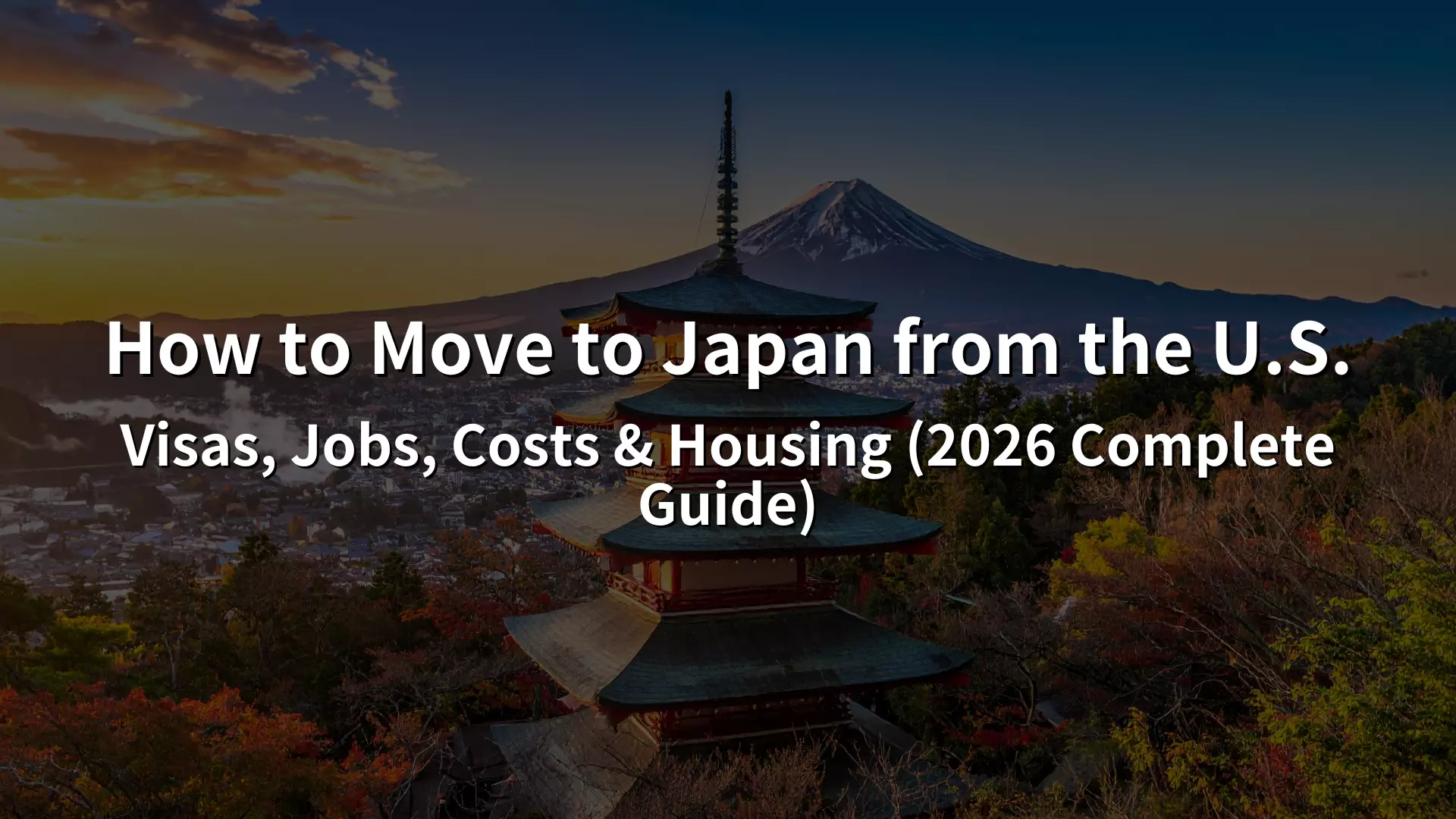
Can Americans Move to Japan? (Is It Hard to Relocate from the US?)
Yes, Americans absolutely can move to Japan—and thousands do every year. According to Japan’s Ministry of Justice, there are over 60,000 US citizens registered as residents in Japan, making Americans one of the largest Western expat communities in the country.
That said, Japan does not offer a “move here and figure it out later” option. Unlike some countries with freelance or digital nomad visas, Japan’s immigration system requires you to have a specific purpose for your stay: a job offer, enrollment in a school, marriage to a Japanese national, or another qualifying status. You cannot simply arrive on a tourist visa and start working or searching for long-term housing without the proper residence status.
The good news is that the process, while structured, is entirely manageable with proper planning. US citizens enjoy visa-free entry for short-term visits of up to 90 days, which means you can visit Japan to scope out neighborhoods, attend job interviews, or tour language schools before committing to your move. And once you secure the right visa, Japan’s bureaucratic systems—while thorough—are efficient and well-documented.
The level of difficulty depends largely on your situation. If you have a job offer from a Japanese company or a multinational corporation with a Japan office, the process is relatively straightforward. If you are a student enrolling in a Japanese language school or university, the path is clear. If you are marrying a Japanese national, immigration procedures are well-established. For those without any of these anchors, the process requires more creativity and planning—but it is far from impossible.
Visa Options for Moving to Japan from the US
Your visa determines everything about your life in Japan—what you can do, how long you can stay, and what rights you have. Japan offers a variety of visa categories, and understanding which one fits your situation is the critical first step in your relocation journey. Here is a detailed breakdown of the most common visa options for Americans.
Work Visas
Work visas are the most common pathway for Americans relocating to Japan. Japan offers more than a dozen subcategories of work visas, each tied to a specific professional activity. The most frequently used categories include Engineer/Specialist in Humanities/International Services (the most common for office professionals, IT workers, translators, and marketing specialists), Instructor (for those teaching at schools and educational institutions), Intra-company Transferee (for employees transferred from an overseas office to a Japan branch), and Business Manager (for entrepreneurs starting or managing a business in Japan).
To qualify for a work visa, you generally need a bachelor’s degree or at least ten years of relevant professional experience. Your employer in Japan acts as your sponsor and submits the application to the Immigration Services Agency. The process typically involves obtaining a Certificate of Eligibility (COE), which your employer applies for on your behalf. Once the COE is issued, you take it to a Japanese consulate in the US to receive your visa stamp. Processing times for the COE range from one to three months, so plan accordingly.
English teaching remains one of the most accessible entry points for Americans. Programs like JET (Japan Exchange and Teaching) and private companies such as Interac, AEON, and ECC recruit thousands of native English speakers annually. These positions typically provide visa sponsorship and sometimes even help with housing.
Student Visas
The student visa is a popular and practical option, especially for Americans who want to learn Japanese, experience Japanese culture, or use the visa as a stepping stone to a work visa. To qualify, you need acceptance from a recognized educational institution in Japan—this could be a Japanese language school, a vocational college (senmon gakko), or a university.
Immigration typically requires you to demonstrate financial stability, usually through bank statements showing approximately ¥2–3 million (roughly $13,000–$20,000) in savings, or a financial sponsor who can support your living expenses. Student visa holders are permitted to work part-time up to 28 hours per week during the school term, which helps offset living costs. Many Americans use the student visa pathway to build language skills and professional networks in Japan before transitioning to a work visa.
Spouse & Dependent Visas
If you are married to a Japanese national, you can apply for a Spouse or Child of a Japanese National visa, which is one of the most flexible residence statuses available. This visa has no restrictions on the type of work you can do, and it typically requires proof of a genuine marriage, financial stability, and your spouse’s tax records.
The Dependent visa is for family members (spouse and children) of someone already residing in Japan on a valid work or student visa. Dependent visa holders can apply for permission to work part-time up to 28 hours per week.
Highly Skilled Professional Visa
Japan’s Highly Skilled Professional (HSP) visa is designed to attract top-tier international talent. It uses a points-based system that evaluates your academic background, professional experience, annual salary, age, and other factors. If you score 70 points or more, you qualify for preferential immigration treatment, including a longer initial period of stay (five years), relaxed requirements for bringing family members, and a faster path to permanent residency.
Scoring 80 points or more is even more advantageous—you become eligible for permanent residency after just one year in Japan, compared to the standard ten-year requirement. This visa category is particularly attractive for professionals in technology, finance, research, and other highly skilled fields.
Permanent Residency (Long-Term Path)
Permanent residency in Japan is not a visa you apply for from overseas—it is a status you work toward after living in Japan for an extended period. The standard requirement is ten years of continuous residence, including at least five years on a work visa. However, this timeline can be shortened significantly for Highly Skilled Professional visa holders (one to three years) and spouses of Japanese nationals (typically one to three years of marriage while living in Japan).
Permanent residents enjoy nearly all the same rights as Japanese citizens, including unrestricted work authorization and no need for visa renewals. The application process requires demonstrating good conduct, financial independence, and contributions to Japanese society.
Search for a room
Only furnished properties with appliances are listed!
Step-by-Step Process: How to Move to Japan from the US
Moving to Japan from the US involves several key steps that should be completed in a specific order for the smoothest experience. Here is your timeline and checklist.
6–12 Months Before Your Move
- Research visa options and determine which category fits your situation.
- If pursuing a work visa, begin your job search through platforms like GaijinPot Jobs, LinkedIn Japan, and company career pages.
- If pursuing a student visa, research and apply to Japanese language schools or universities. Application deadlines are typically several months before each intake (April and October are the main start dates).
- Start learning basic Japanese. Even a foundation in hiragana, katakana, and basic conversational phrases will make your transition significantly easier.
- Begin gathering required documents: a valid US passport (ensure it remains valid for the duration of your intended stay), university transcripts and degree certificates, professional references, and financial statements.
3–6 Months Before Your Move
- Secure your job offer or school acceptance letter.
- Your employer or school begins the Certificate of Eligibility (COE) application process with Japan’s Immigration Services Agency.
- Research housing options in your target city. XROSS HOUSE is an excellent starting point for Americans, offering furnished share houses and apartments in Tokyo with no guarantor requirements, no key money, and multilingual support.
- Plan your budget for initial expenses, including flights, move-in costs, and living expenses for the first few months.
- Arrange to have important documents apostilled or notarized as needed.
1–3 Months Before Your Move
- Once your COE arrives, submit your visa application at the nearest Japanese consulate or embassy in the US. US citizens are exempt from visa fees.
- Book your flights. One-way tickets from the US to Japan typically range from $400–$1,200 depending on the season and airline.
- Decide what to ship versus what to buy in Japan. Many Americans find it more practical to ship only essential personal items and purchase furniture and household goods locally.
- Notify your US bank of your international relocation and research options for banking in Japan.
- Set up an international phone plan or research Japanese mobile providers.
After Arrival in Japan
- At the airport, present your passport, COE, and visa to immigration. You will receive your Residence Card (zairyu card) at the airport if arriving at Narita, Haneda, Kansai, or Chubu airports.
- Within 14 days of settling into your residence, register your address at your local municipal ward office (kuyakusho or shiyakusho).
- Enroll in the National Health Insurance program (if not covered by your employer’s insurance).
- Open a Japanese bank account. Some banks require you to have lived in Japan for at least six months, but options like Japan Post Bank (Yucho Ginko), Shinsei Bank, and digital banks like Wise or Revolut offer quicker access.
- Get a Japanese mobile phone number—essential for everything from bank accounts to delivery services.
- Register for the national pension system (kokumin nenkin) if applicable.
How Much Does It Cost to Move to Japan from America?
One of the most common questions Americans ask is how much they should budget for the move itself. The total cost varies significantly depending on your circumstances, but here is a realistic breakdown of the major expenses.
Pre-Departure Costs
- One-way flight from the US to Japan: $400–$1,200 (economy class, depending on departure city, season, and airline)
- Visa application fees: $0 for US citizens (Japan waives visa fees for Americans)
- Document preparation (apostille, translations, etc.): $100–$500
- International shipping of personal belongings: $1,000–$5,000+ depending on volume and shipping method
- Travel insurance for the transition period: $50–$200
Housing Move-In Costs in Japan
Traditional apartment rentals in Japan come with notoriously high upfront costs. For a standard apartment in Tokyo, expect to pay a total of four to six months’ rent upfront, which typically includes a security deposit (one to two months’ rent), key money (a non-refundable gift to the landlord, typically one to two months’ rent), real estate agent fees (one month’s rent plus tax), guarantor company fees (50–100% of one month’s rent), first month’s rent, and fire insurance.
For example, if you rent an apartment at ¥80,000 per month, your total move-in cost could easily exceed ¥350,000–¥480,000 (roughly $2,300–$3,200). This is where XROSS HOUSE offers a major advantage: with initial costs starting from just ¥30,000 and monthly rent from ¥29,800, plus no key money, no guarantor fees, and fully furnished rooms, you can save hundreds of thousands of yen compared to a traditional apartment rental.
Total Estimated Budget
For a realistic budget, most Americans should plan to have at least $5,000–$10,000 saved before moving to Japan. This covers your flight, initial housing costs, living expenses for the first one to two months, and an emergency cushion. If you are shipping belongings, planning to rent a traditional apartment, or moving to an expensive area like central Tokyo, budget on the higher end.
Search for a room
Only furnished properties with appliances are listed!
Cost of Living in Japan vs the United States
One of the biggest surprises for Americans moving to Japan is that everyday life can actually be more affordable than in many US cities. According to Numbeo’s 2025–2026 data, a single person in the US spends an average of approximately ¥410,000 per month, while a single person in Japan averages around ¥218,000—nearly 47% less.
Here is how the major cost categories compare:
Housing
Rent is generally lower in Japan than in major US cities. A one-bedroom apartment in central Tokyo averages ¥100,000–¥150,000 ($650–$1,000) per month, which is comparable to or less than rent in cities like New York, San Francisco, or Los Angeles. Outside Tokyo, rent drops dramatically—¥60,000–¥80,000 in Osaka or Nagoya, and as low as ¥30,000–¥50,000 in smaller cities. Share houses like XROSS HOUSE offer even more affordable options starting from ¥29,800 per month in Tokyo, including furnished rooms and utilities.
Food and Dining
Eating out in Japan is remarkably affordable compared to the US. A bowl of ramen costs ¥800–¥1,200 ($5–$8), a set lunch at a restaurant runs ¥700–¥1,000, and convenience store meals (surprisingly delicious in Japan) cost ¥300–¥600. Monthly grocery expenses for a single person typically range from ¥30,000–¥50,000 ($200–$330). Eating local and cooking at home is significantly cheaper than in most American cities.
Transportation
Japan’s world-class public transportation system means most residents do not need a car. A monthly commuter pass in Tokyo costs ¥10,000–¥20,000 ($65–$130) depending on distance, which is far less than car payments, insurance, gas, and parking in the US. Even without a pass, individual train rides cost ¥140–¥400.
Healthcare
Healthcare in Japan is significantly more affordable than in the US. Japan’s national health insurance covers 70% of medical costs, with patients paying just 30% out of pocket. Monthly premiums are income-based and typically range from ¥10,000–¥50,000, which is a fraction of what Americans pay for health insurance. There are no surprise medical bills or insurance networks to navigate.
Utilities and Services
Monthly utilities for a single person (electricity, gas, water) average about ¥12,000–¥13,000 ($80–$85). Home internet costs ¥4,000–¥6,000 per month, and mobile phone plans range from ¥2,000 for budget MVNOs to ¥6,000–¥8,000 for major carriers with
English support.
Where to Live in Japan as an American
Choosing where to live is one of the most exciting—and consequential—decisions you will make. Each city in Japan offers a distinct experience, and the right choice depends on your career, lifestyle preferences, and budget.
Tokyo
As Japan’s capital and largest metropolis, Tokyo is the top destination for American expats. The city offers unparalleled job opportunities (especially in tech, finance, education, and international business), a massive international community, and English-friendly services. Popular neighborhoods for expats include Shibuya, Shinjuku, Roppongi, Minato, Meguro, and Setagaya. While Tokyo has the highest cost of living in Japan, salaries are correspondingly higher. The city’s transportation network is the best in the world, and you can access virtually anything you need in English. XROSS HOUSE operates numerous share houses across Tokyo’s most convenient locations, giving newcomers easy access to popular neighborhoods at affordable prices.
Osaka
Known as Japan’s kitchen and cultural capital, Osaka offers a more relaxed, affordable, and outgoing atmosphere compared to Tokyo. Osaka residents are famous for their friendliness and humor, which can make the cultural transition easier for Americans. The city has a thriving food scene (street food in Dotonbori is legendary), a strong job market particularly in manufacturing and commerce, and living costs approximately 15–25% lower than Tokyo. Osaka also serves as a gateway to Kyoto, Nara, and Kobe.
Yokohama
Located just 30 minutes south of central Tokyo by train, Yokohama offers a unique blend of urban convenience and waterfront living. As Japan’s second-largest city, Yokohama has a long history of international exchange (it was one of the first ports opened to foreign trade) and maintains a cosmopolitan atmosphere. Rent is generally lower than central Tokyo while still providing easy access to Tokyo’s job market via excellent train connections.
Fukuoka
Fukuoka, on the southern island of Kyushu, has been gaining popularity among international residents for its excellent quality of life, startup-friendly environment, and affordable cost of living. The city is compact and bikeable, has beautiful beaches, and is known for its food (especially Hakata ramen and yatai street food stalls). While the English-speaking community is smaller than in Tokyo, Fukuoka’s international startup scene is growing rapidly.
Rural Japan (Inaka Life)
For Americans seeking a completely different experience, rural Japan (known as inaka) offers incredibly low living costs, stunning natural beauty, and deep cultural immersion. Some local governments actively recruit international residents with subsidies, free or nearly free housing, and community support programs. The trade-offs include limited job opportunities (remote work or farming are common), minimal English-language services, and the need for strong Japanese language skills. However, for those who embrace it, inaka life can be deeply rewarding.
Search for a room
Only furnished properties with appliances are listed!
Housing in Japan: What Americans Need to Know
Finding housing is often cited as the most stressful part of moving to Japan, especially for foreigners. The Japanese rental market has unique customs and costs that differ significantly from the US. Here is what you need to understand.
Apartments vs Share Houses
Traditional apartments in Japan range from tiny one-room units (1R or 1K, typically 15–25 square meters) to larger family-sized units (2LDK, 3LDK). Most apartments come unfurnished—this means no furniture, no appliances, and often no light fixtures. You will need to purchase everything from a refrigerator to a curtain rod.
Share houses have become an increasingly popular alternative, especially among international residents and young professionals. A share house provides a private room in a furnished building with shared common areas (kitchen, living room, bathroom). The advantages are significant: lower cost, fully furnished rooms, no key money, flexible lease terms, built-in community, and easier application processes for foreigners.
XROSS HOUSE is one of Tokyo’s leading share house providers for international residents. With over 400 properties across Tokyo, rooms starting from just ¥29,800 per month, and no guarantor or key money requirements, XROSS HOUSE eliminates the biggest barriers that Americans face when searching for housing in Japan. Every room comes fully furnished with a bed, desk, storage, and Wi-Fi, so you can move in with just a suitcase.
Initial Move-In Costs (Key Money, Deposit, Fees)
One of the biggest shocks for Americans is the upfront cost of renting a traditional apartment in Japan. Here is what you typically need to pay before moving in:
- Security deposit (shikikin): One to two months’ rent, partially refundable when you move out.
- Key money (reikin): One to two months’ rent as a non-refundable “gift” to the landlord. This is a uniquely Japanese custom with no equivalent in the US.
- Agent fee (chukai tesuryo): One month’s rent plus consumption tax, paid to the real estate agency.
- Guarantor company fee (hoshounin kaisha): 50–100% of one month’s rent. Since most foreigners do not have a Japanese guarantor, you will likely need to use a guarantor company.
- First month’s rent: Paid in advance.
- Fire insurance: Approximately ¥15,000–¥20,000 for a two-year policy.
The total often adds up to four to six months’ rent paid upfront—a significant financial burden for newcomers.
Guarantor Requirements
Nearly all landlords in Japan require a guarantor (hoshounin)—someone who agrees to cover your rent if you fail to pay. For Japanese nationals, a family member typically serves this role. For foreigners, this requirement presents a significant challenge, as most Americans do not have a suitable guarantor in Japan. Guarantor companies (hoshougaisha) exist to fill this gap, but they add to your move-in costs. Some foreign-friendly housing providers, including XROSS HOUSE, eliminate this requirement entirely.
Foreign-Friendly Housing Options
Not all landlords in Japan are willing to rent to foreigners. While the situation has improved significantly in recent years, some property owners still prefer Japanese tenants due to language barriers, cultural differences, or concerns about early lease termination. To avoid frustration, focus your search on properties and companies that explicitly welcome international residents.
XROSS HOUSE specializes in providing housing for international residents, with a simple application process, multilingual support, and none of the traditional barriers like key money or guarantor requirements. Other foreign-friendly options include UR Housing (government-managed apartments with no key money or agent fees), serviced apartments, monthly mansions, and international real estate agencies.
How to Find an Apartment in Japan as a Foreigner
Searching for housing in Japan as a foreigner requires a different approach than what you might be used to in the US. Here are the most effective strategies:
- Start your search online before arriving. Major English-language property search platforms include GaijinPot Apartments, Real Estate Japan, Suumo (with Google Translate), and XROSS HOUSE’s website (xrosshouse.com) for share houses and furnished rooms in Tokyo.
- Consider arriving first and staying in temporary accommodation (a share house, hostel, or monthly rental) while you search for a longer-term option. This allows you to visit properties in person and get a feel for different neighborhoods.
- If you use a traditional real estate agency, look for one with English-speaking staff. Bring your residence card, passport, proof of employment (or school enrollment), and proof of income.
- Be prepared to act quickly. In popular areas, good properties move fast. Having your documents ready and being able to make decisions promptly gives you a significant advantage.
- For the easiest experience, especially if this is your first time in Japan, a share house like XROSS HOUSE lets you secure housing from overseas with a simple online application and move in immediately upon arrival in Tokyo.
Shipping Your Belongings from the US to Japan
Deciding what to bring and what to leave behind is a practical—and emotional—challenge. Here is what you need to know about shipping your belongings from the US to Japan.
What to Bring vs. What to Buy in Japan
Many experienced expats recommend shipping as little as possible. Japan has excellent shopping options for furniture, appliances, electronics, and household goods, often at very reasonable prices. Stores like Nitori (Japan’s IKEA equivalent), Don Quijote, Muji, Daiso (100-yen shops), and countless secondhand shops make it easy to set up a new home. Items worth shipping include personal mementos, specialty clothing (larger sizes can be harder to find in Japan), prescription medications (with proper documentation), important documents, and professional tools specific to your work.
Shipping Methods and Costs
There are three main options for shipping belongings internationally:
- Air freight: Fastest option (5–10 days) but the most expensive. Best for essential items you need immediately. Expect to pay $5–$10 per pound.
- Sea freight: Most cost-effective for large volumes. Takes 4–8 weeks for door-to-door delivery. A small shipment (50–100 cubic feet) typically costs $1,000–$3,000.
- International courier services: USPS, FedEx, and UPS offer international shipping. USPS is usually the most affordable for smaller packages.
When shipping to Japan, be aware of customs regulations. Certain items are restricted or prohibited, including some medications, certain food products, and items containing lithium batteries. Japan customs may also charge duties on new items above a certain value. Always declare your shipments accurately and keep receipts.
Healthcare System in Japan for Americans
Japan’s healthcare system is one of the best in the world, and understanding how it works will put your mind at ease. All residents of Japan—including foreign nationals with a residence status of three months or more—are required to enroll in health insurance.
How Japanese Health Insurance Works
If you are employed by a Japanese company, you will be enrolled in your employer’s health insurance plan (shakai hoken), which covers medical care and provides additional benefits like maternity leave and sick pay. If you are self-employed, a student, or otherwise not covered by an employer, you enroll in the National Health Insurance program (kokumin kenko hoken) through your local municipal office.
Under both systems, you pay just 30% of medical costs out of pocket. The remaining 70% is covered by insurance. Monthly premiums are based on your income—for National Health Insurance, expect to pay roughly ¥10,000–¥50,000 per month depending on your earnings and municipality. This is dramatically less than what most Americans pay for health insurance in the US.
Quality and Accessibility of Care
Japan has an extensive network of hospitals, clinics, and pharmacies. You generally do not need a referral to see a specialist, and waiting times are typically shorter than in many Western countries. In Tokyo and other major cities, you can find English-speaking doctors and clinics catering to international patients. The AMDA International Medical Information Center and the Japan Healthcare Info website are excellent resources for locating English-speaking medical services.
For Americans with specific medical needs, it is important to note that some medications available over the counter or by prescription in the US are controlled or prohibited in Japan. Stimulant medications for ADHD, certain cold medicines containing pseudoephedrine, and some painkillers may fall into this category. Always check Japan’s medication regulations and obtain a “yakkan shoumei” (medicine import certificate) for prescription medications before your move.
Taxes in Japan for US Citizens (What You Must Know)
Understanding your tax obligations is crucial because, as a US citizen, you are subject to both Japanese and US tax requirements—a reality that catches many Americans off guard.
Japanese Tax Obligations
As a resident of Japan, you are required to pay Japanese income tax on your worldwide income (after becoming a permanent tax resident, which generally occurs after five years). Japan’s income tax rates are progressive, ranging from 5% to 45% depending on your income level. In addition, you will pay resident tax (juminzei) of approximately 10% of your income, which is assessed by your local municipality.
Employers typically handle income tax withholding through monthly payroll deductions and an annual year-end adjustment. If you are self-employed or have additional income sources, you will need to file a tax return (kakutei shinkoku) between February 16 and March 15 each year.
US Tax Obligations
Unlike citizens of most other countries, US citizens are required to file a US federal tax return regardless of where they live in the world. This means you must file your annual 1040 with the IRS even while living in Japan. You also need to report any foreign financial accounts exceeding $10,000 at any point during the year using the FBAR (FinCEN Form 114).
The good news is that the Foreign Earned Income Exclusion (FEIE) allows you to exclude a significant portion of your foreign-earned income from US taxation—over $120,000 for tax year 2024, with the amount adjusting annually for inflation. Additionally, the US-Japan Tax Treaty helps prevent double taxation on the same income. However, navigating these rules can be complex, and consulting a tax professional experienced in US expatriate taxes is highly recommended. Services like Taxes for Expats, Greenback Expat Tax Services, and H&R Block’s expat division specialize in this area.
Banking, Phones & Daily Essentials After Arrival
Getting set up with essential services after arriving in Japan involves a few steps that can feel circular at first (you need a bank account to get a phone, but some phone carriers want a bank account), but it is all manageable with the right approach.
Banking in Japan
Opening a Japanese bank account is essential for receiving your salary, paying rent, and handling daily transactions. Japan is still very much a cash-based society compared to the US, though cashless payment is growing rapidly. Major bank options include Japan Post Bank (Yucho Ginko), which is the most foreigner-friendly traditional bank and has branches in every post office nationwide; Shinsei Bank, which offers English online banking and ATM services; and digital banking options like Wise, Revolut, and Sony Bank, which provide convenient alternatives with English interfaces. Most major banks require your residence card, passport, a Japanese phone number, and proof of address. Some banks have a six-month residency requirement, so having an alternative like Wise or Revolut for your first months is a smart strategy.
Mobile Phone Service
A Japanese phone number is essential for daily life—from registering for services to two-factor authentication on apps. Your main options include major carriers (NTT Docomo, au/KDDI, SoftBank) which offer the most comprehensive coverage and English support but at higher prices (¥6,000–¥8,000/month); MVNOs or budget carriers (IIJmio, Mobal, Sakura Mobile, LINE Mobile) which offer English-friendly plans at lower prices (¥2,000–¥4,000/month); and eSIM providers like Ubigi or Holafly for immediate connectivity upon arrival.
Many newcomers start with a budget carrier that offers SIM-only plans without long-term contracts.
Residence Card, My Number, and Other Essentials
Your residence card (zairyu card) is the most important document you carry in Japan. You are legally required to have it with you at all times. After registering your address at the municipal office, you will receive a My Number card (kojin bango), which serves as your social security equivalent for tax administration, social insurance, and eventually banking and government services. Other essentials to set up early include a Suica or Pasmo transit card (for trains and buses, also usable for convenience store purchases), Amazon Japan and Rakuten accounts for online shopping, and registering with your nearest embassy or consulate for emergency notifications.
Cultural Differences Between Japan and the US
Understanding cultural differences will help you navigate daily life and build meaningful relationships in Japan. While Japan is a modern, globally connected country, its social norms differ significantly from American culture in several key areas.
Communication Styles
Japanese communication tends to be more indirect than American communication. Where Americans might value directness and assertiveness, Japanese culture prioritizes harmony (wa), reading the atmosphere (kuuki wo yomu), and avoiding confrontation. In business settings, decisions are often made through consensus rather than individual authority. Silence is not uncomfortable—it is a natural part of conversation. Learning to navigate these communication styles takes time, but showing respect and patience goes a long way.
Daily Life Etiquette
Japan has many social customs that differ from the US. Shoes are removed before entering homes, many offices, schools, and some restaurants. Bowing is the standard greeting rather than handshaking. Tipping is not practiced and can actually be considered rude. Garbage separation is strict and varies by municipality. Trains and public spaces are kept extremely quiet—talking on the phone on public transport is considered inconsiderate. Punctuality is taken very seriously in both personal and professional contexts.
Work Culture
Japanese work culture has a reputation for long hours and hierarchical structures, though this is gradually changing, especially at international companies and startups. The concept of “nomikai” (after-work drinking gatherings) is an important aspect of team building. While not mandatory, participating shows team spirit. Work-life balance varies significantly between companies—international firms and tech companies often offer more flexibility than traditional Japanese corporations.
Language Barrier
While English is widely taught in Japanese schools, everyday English proficiency varies significantly outside of major international hubs. In Tokyo and Osaka, you can manage many daily tasks in English, but investing in Japanese language study will dramatically improve your quality of life, professional opportunities, and social connections. Many Japanese people appreciate any effort to speak their language, even at a beginner level.
Pros and Cons of Moving to Japan from the US
Before making the leap, it helps to weigh the advantages and challenges honestly.
Pros
- Safety: Japan consistently ranks among the safest countries in the world. Violent crime is extremely rare, and you can walk alone at night in virtually any neighborhood without concern.
- Healthcare: Affordable, high-quality healthcare with universal coverage.
- Public transportation: World-class trains, buses, and subways that are clean, punctual, and affordable.
- Food: Incredible quality and variety at all price points, from Michelin-starred restaurants to ¥500 convenience store lunches.
- Cultural richness: Ancient temples next to ultramodern skyscrapers, seasonal festivals, rich artistic traditions.
- Cleanliness: Cities and public spaces are remarkably clean and well-maintained.
- Cost of living: Generally lower than major US cities, especially for food, healthcare, and transportation.
- Technology and convenience: From heated toilet seats to 24/7 convenience stores with ATMs and fresh food, daily life in Japan is extraordinarily convenient.
Cons
- Language barrier: Limited English outside major cities can be isolating without Japanese skills.
- Bureaucracy: Paperwork and administrative processes can be complex and rigid.
- Work culture: Some companies have demanding work hours and hierarchical structures.
- Housing challenges: Small living spaces, high upfront rental costs, and some landlords reluctant to rent to foreigners.
- Social integration: Building deep friendships can take longer due to cultural and language barriers.
- Natural disasters: Japan experiences earthquakes, typhoons, and occasional flooding, though infrastructure is well-prepared.
- Distance from family: The US is far from Japan, making visits home expensive and time-consuming.
- Dual tax obligations: US citizens must file taxes in both countries.
Common Mistakes Americans Make When Moving to Japan
Learning from others’ experiences can save you significant time, money, and frustration. Here are the most common mistakes Americans make—and how to avoid them.
- Not saving enough before moving. Japan’s high upfront housing costs and the time it takes to receive your first paycheck mean you need a substantial financial cushion. Aim for at least three months’ living expenses in savings.
- Ignoring Japanese language study. While you can survive in English in Tokyo, even basic Japanese dramatically improves your daily life, career prospects, and social connections. Start studying before you arrive.
- Shipping too much from the US. Many Americans spend thousands shipping furniture and household items that could be purchased cheaply in Japan. Ship only what is irreplaceable or deeply personal.
- Not researching housing before arrival. Arriving in Japan without a housing plan leads to expensive hotel stays and rushed decisions. Book temporary accommodation or reserve a share house like XROSS HOUSE in advance.
- Forgetting about US tax obligations. The IRS requires you to file regardless of where you live. Failing to file can result in penalties. Set up a system with an expat tax specialist from day one.
- Trying to maintain an American lifestyle. Importing American food, insisting on a large apartment, and avoiding Japanese customs will make your experience more expensive and less fulfilling. Embrace the local lifestyle.
- Underestimating cultural adjustment. Culture shock is real and can hit at unexpected times. Give yourself grace, connect with other expats, and be patient with the adjustment process.
- Not getting proper health insurance immediately. Some newcomers delay enrollment, leaving themselves vulnerable to massive medical bills. Enroll in health insurance within 14 days of obtaining your residence card.
Is Moving to Japan from the US Worth It?
This is ultimately a personal question, but for the vast majority of Americans who make the move, the answer is a resounding yes. Living in Japan offers an experience that is fundamentally different from anything you can find in the United States—and that difference is precisely what makes it so valuable.
The daily pleasures of life in Japan are remarkable: walking through safe, clean streets at any hour; eating world-class food at remarkably affordable prices; riding bullet trains through stunning mountain scenery; experiencing the beauty of cherry blossom season; participating in vibrant local festivals; and discovering the warmth and generosity that lies beneath Japan’s formal exterior.
Professionally, Japan offers opportunities that can accelerate your career in unique ways. Experience working in one of the world’s largest economies, proficiency in the Japanese language, and understanding of Japanese business culture are highly valued skills globally.
The challenges are real—loneliness, language barriers, cultural miscommunication, and distance from family will all test you at various points. But most long-term American residents in Japan will tell you that the personal growth, cultural enrichment, and life experiences gained far outweigh the difficulties.
If you are considering the move but feel overwhelmed by the logistics, start with one manageable step. Research your visa options. Book a scouting trip. Enroll in a Japanese class. And when you are ready to secure housing, XROSS HOUSE makes it simple—browse available rooms online, apply from the US, and have your Tokyo home waiting for you when you arrive.
Summary: Moving to Japan from the US Made Simple
Moving to Japan from the United States is an achievable dream with the right preparation. Here is a quick recap of the key points covered in this guide:
- Americans can move to Japan, but you need a valid visa tied to a specific purpose (work, study, marriage, etc.).
- Common visa options include work visas, student visas, spouse visas, and the Highly Skilled Professional visa.
- The step-by-step process involves securing your anchor (job, school, or other qualifying status), obtaining a Certificate of Eligibility, applying for your visa at a US consulate, and completing registration after arrival.
- Budget at least $5,000–$10,000 for your move, covering flights, housing, and initial living expenses.
- Cost of living in Japan is generally lower than in major US cities, especially for food, healthcare, and transportation.
- Tokyo, Osaka, Yokohama, and Fukuoka are the most popular cities for American expats, each with distinct advantages.
- Housing can be challenging due to high upfront costs and guarantor requirements—share houses like XROSS HOUSE eliminate these barriers with affordable furnished rooms, no key money, and no guarantor needed.
- Japan’s healthcare system is excellent and affordable, with universal coverage for all residents.
- US citizens must file taxes in both Japan and the US, but treaties and exclusions help prevent double taxation.
- Cultural adjustment takes time, but the rewards of living in Japan—safety, food, culture, and personal growth—make it well worth the effort.
Your journey to Japan starts with a single step. Whether you are years away from your move or weeks away from boarding a plane, we hope this guide has given you the clarity and confidence to move forward. And when you are ready for housing, XROSS HOUSE is here to make your first home in Japan as welcoming and hassle-free as possible.